How to Make Bamboo Basket Step by Step Guide
Introduction to Bamboo Basket Weaving
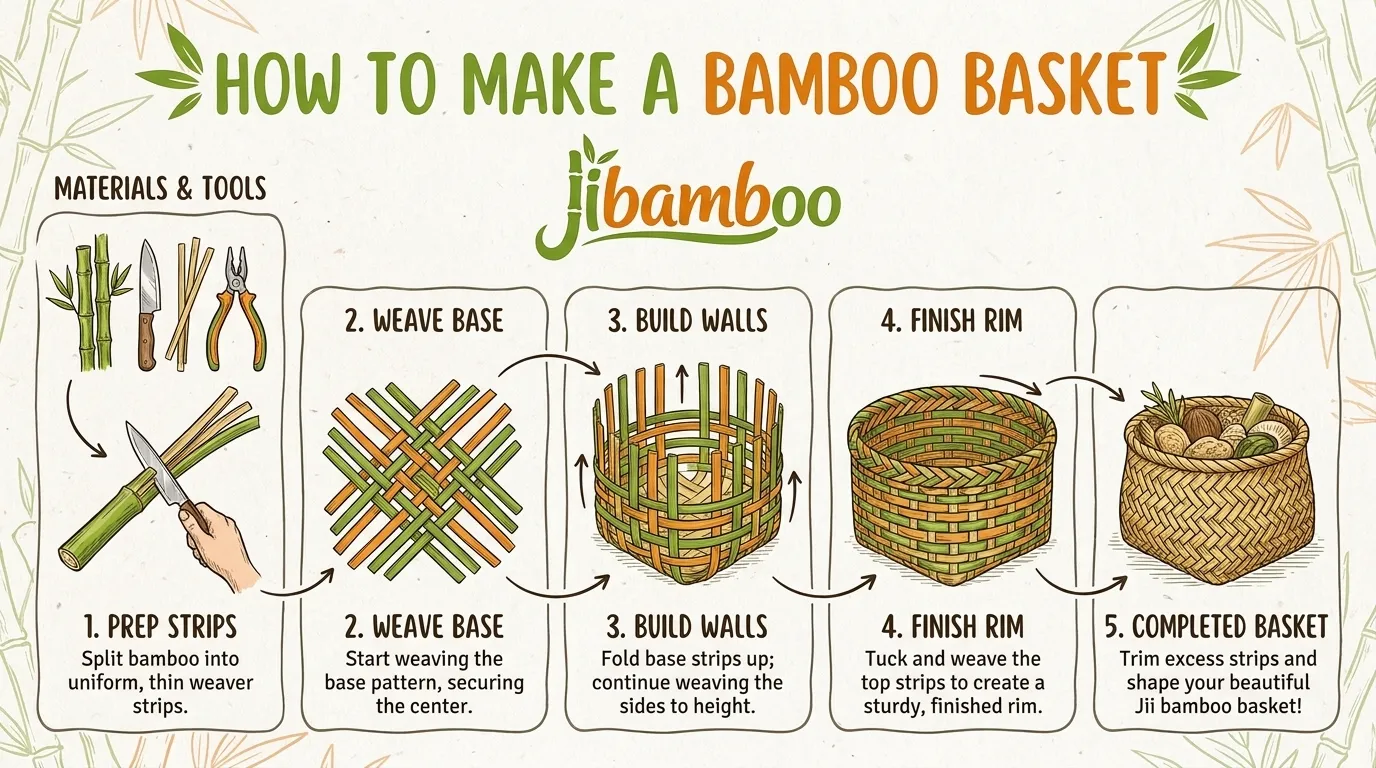
Mastering how to make bamboo basket products begins with appreciating the raw potential of this remarkable grass. As a sustainable alternative to plastics, bamboo weaving combines functional utility with sophisticated artistry. Whether for industrial supply or home decor, understanding the foundational properties of bamboo is the first step toward creating a high-quality woven bamboo basket.
Benefits of Using Bamboo for Crafting
Bamboo is the preferred material for professional weavers due to its unique physical properties and environmental credentials.
| Feature | Advantage in Basketry |
|---|---|
| Sustainability | Rapidly renewable; matures in 3–5 years. |
| Tensile Strength | Comparable to steel, allowing for thin yet strong strips. |
| Flexibility | High elasticity ensures strips bend without snapping. |
| Lightweight | Ideal for large-scale storage and transport containers. |
Understanding Bamboo Anatomy and Fiber Strength
The secret to a durable bamboo stick basket lies in the plant\’s anatomy. Unlike wood, bamboo fibers are longitudinal and concentrated toward the outer skin (the \”rind\”).
- Vascular Bundles: These provide the rigid structure and high density.
- Silica Content: The outer layer offers natural resistance to moisture and pests.
- Node vs. Internode: Internodes provide the straightest, most flexible fibers for weaving, while nodes add structural integrity.
Historical Significance of Bamboo Basketry
For millennia, the craft of the woven bamboo basket has been a cornerstone of global trade and daily life. Historically, these vessels were essential for agriculture, fishing, and food storage. Today, this ancient technique remains a symbol of cultural heritage and artisanal precision, bridging the gap between traditional craftsmanship and modern eco-conscious manufacturing. Embracing these methods allows you to make bamboo basket items that are both timeless and functional.
Essential Tools and Materials Needed
To make a bamboo basket, you need a specific setup. As a Bamboo Manufacturer and Supplier, I’ve learned that using the wrong tools or the wrong species is the fastest way to fail.
Primary Tools for Cutting and Splitting
I rely on a few specialized tools to handle the plant\’s tough exterior and get the strips just right:
- Machete or Billhook: Essential for harvesting and the initial vertical split of the culm.
- Bamboo Splitter: A star-shaped steel tool that divides the pole into 4, 6, or 8 equal sections instantly.
- Refining Knife: Used for smoothing the nodes and thinning the inner wall of the strips.
- Measuring Tape: Critical to keep your strips consistent for a uniform woven bamboo basket.
Selecting the Best Bamboo Species for Weaving
Not every stalk is suitable for bamboo basket making. I suggest using species like Moso or Henon because their long fibers provide the flexibility needed for tight bends. If you want to see how high-quality species translate into professional products, you can check out our bamboo storage box designs to see the ideal finish and grain. Selecting 3-year-old culms ensures the material is neither too soft nor too brittle.
Safety Equipment for Beginners
Freshly split bamboo is as sharp as a razor. To make bamboo stick basket projects safely, I always use the following:
- Cut-Resistant Gloves: These are non-negotiable when thinning and smoothing strips.
- Safety Glasses: To protect your eyes from flying splinters during the splitting phase.
- Sturdy Apron: Protects your clothes and lap while you are shaving down the material.
- Sanding Block: To dull any jagged edges before you start the actual weaving process.
Preparing Your Bamboo Strips
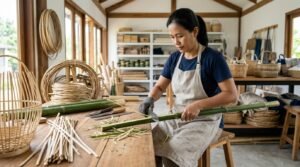
Preparing high-quality material is the most critical step when learning how to make bamboo basket items that last. I focus on creating strips that are uniform, flexible, and free of burrs to ensure a smooth weaving process.
How to Harvest and Season Bamboo
To make bamboo basket products that don\’t warp or crack, I select culms that are at least 3 to 5 years old.
- Harvesting: Cut bamboo during the dry season to minimize starch content, which helps prevent pest infestations.
- Seasoning: Stack the culms vertically in a shaded, well-ventilated area. This natural drying process toughens the fibers.
Techniques for Splitting Bamboo Culms
Splitting is the core of bamboo basket make techniques. I use a heavy-duty bamboo splitter or a sharp cleaver to get clean lines.
- Place the blade across the top of the culm.
- Apply even pressure to split the bamboo into halves.
- Continue subdividing until you have thin, workable widths.
Thinning and Smoothing Strips for Flexibility
Uniform thickness is what separates a basic craft from a professional-grade OEM bamboo food tray. I use a sharp knife to shave away the inner pith—the soft, white part—until only the strong, flexible outer skin remains.
- Smooth the edges: Run a knife along the sides at a slight angle to remove sharp splinters.
- Gauge the thickness: Thinner strips are essential for intricate weaving, while thicker ones provide the necessary structural support for the base.
Soaking Methods to Prevent Splitting
Before you begin the how to make a bamboo basket step by step assembly, you must hydrate the fibers to make them pliable.
- Cold Soak: Submerge your prepared strips in water for 1–2 hours.
- Hot Soak: For thicker or older strips, a 20-minute hot water soak increases pliability significantly, allowing for tighter bends without snapping.
- Maintain Moisture: Always keep a damp cloth nearby to wipe down the strips while weaving; this keeps them from becoming brittle as you work.
Step-by-Step Guide to Weaving the Base
Learning how to make bamboo basket projects starts with a solid foundation. The base determines the structural integrity of the entire piece, so I always focus on getting the tension right from the first strip. Following a how to make a bamboo basket step by step approach ensures your base doesn\’t warp as it dries.
Setting Up the Radial Foundation
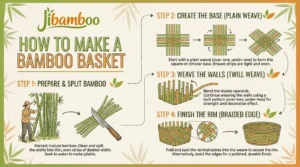
To start, lay out your primary thick strips (the \”spokes\”) in a star or cross pattern. For a standard circular base, I recommend using an odd number of spokes to allow for a continuous spiral weave.
- Alignment: Cross the center strips at 90-degree angles for a square base or a star pattern for round designs.
- Spacing: Ensure the spokes are evenly spaced to prevent gaps in the weave.
- Stability: Hold the center point firmly with one hand or a small weight while you start the first few rounds.
The Over-Under Weaving Technique
Once your spokes are positioned, take a thinner, more flexible weaver strip. This is the core method used to make bamboo basket bottoms at home. I use the simple \”plain weave\” pattern:
- Pass the weaver over the first spoke and under the second.
- Maintain constant pressure, pulling the weaver tight toward the center point.
- Continue this rhythm, ensuring each row sits flush against the previous one.
If you value this type of organized, natural aesthetic for your home, you’ll find that a bamboo makeup organizer offers a similar blend of handcrafted durability and functional storage.
Securing the Base Before Raising the Sides
Before you transition to the walls, the base must be locked. If the weave is loose, the basket will lose its shape. I use a \”twining\” technique for the final row of the base, where two weavers twist around each spoke to create a reinforced border.
- Tightening: Use a small flat-head tool to pack the rows toward the center.
- Measurement: Verify the base diameter matches your design plan before stopping.
- Pre-bending: Once the base is secure, gently crease the spokes upward to prepare for the \”upsettling\” phase. This creates a clean 90-degree angle for the sides.
Building the Sides of the Basket
Transitioning from Base to Walls (Upsettling)
The transition from the flat base to the vertical walls is known as upsettling. This is a pivotal moment when you define the final shape of the container.
- Bending the Spokes: Carefully bend the radial strips upward to a 90-degree angle.
- Locking the Corner: Weave the first row of the wall tightly against these bends. This creates a crisp \”foot\” for the basket and ensures it sits level on flat surfaces.
- The Foundation: This initial row provides the structural tension needed to support the entire height of the walls.
Managing Tension for a Uniform Shape
Consistency is what separates a beginner\’s project from a professional-grade product. When you make bamboo basket walls, your hands must apply even pressure throughout the process.
- Rotate Frequently: Do not weave too much in one spot. Rotate the basket constantly to ensure the tension is distributed equally around the circumference.
- Avoid Tapering: Keep the spokes vertical. If you pull the weaving strips too tight, the basket will begin to \”choke\” or narrow at the top.
- Professional Standards: As an experienced bamboo box manufacturer, I have found that maintaining a steady rhythm is the best way to achieve perfectly straight walls and a symmetrical silhouette.
Adding New Strips Seamlessly
Learning how to make bamboo basket sides look flawless involves mastering the \”hidden join\” technique.
- Overlap Method: When a horizontal strip is about to end, overlap it with a new strip for at least two to three spokes.
- Internal Finishing: Always ensure the ends of the strips (both the old and the new) terminate on the inside of the basket. This keeps the exterior surface smooth and aesthetically pleasing.
- Thinning the Ends: For a truly seamless look, slightly shave down the thickness of the overlapping ends so they don\’t create a noticeable bulge in the weave.
Finishing the Rim and Border
I have found that the rim is the most critical part of any woven bamboo basket. It isn\’t just about looks; the rim provides the structural integrity that keeps the walls from collapsing or unraveling under pressure. A well-finished border ensures that the tension you’ve built into the sides remains locked in place for years of use.
Creating a Sturdy Top Edge
To build a rim that lasts, we typically use the \”sandwich\” method. This involves placing two thick bamboo hoops—one on the inside and one on the outside—around the top of the vertical stakes.
- Aligning the Hoops: Position the inner and outer hoops so they sit flush against the top row of weaving.
- Clamping: Use heavy-duty clips or clothespins to hold the hoops in place before you begin the binding process.
- Stake Preparation: Ensure your vertical stakes are flexible enough to be folded over or trimmed depending on the specific bamboo basket make style you are following.
Traditional Rim Binding Styles
Binding is where the artistry of the bamboo basket how to make process really shines. We use thin, flexible cane or bamboo splits to lash the hoops to the body of the basket.
| Binding Style | Description | Best For |
|---|---|---|
| Simple Wrap | A continuous spiral wrap around the rim hoops. | Utility baskets and beginners. |
| Cross-Stitch (X-Pattern) | Lashing in two directions to create an \”X\” over the rim. | High-stress areas and decorative finishes. |
| Herringbone | An interlocking weave that creates a braided look. | Premium, high-end gift baskets. |
Trimming Excess Material Safely
Once the binding is secure, you need to clean up the protruding stakes. This requires a steady hand and a very sharp blade. A dull knife is dangerous when cutting through tough fibers because it requires more force, which leads to slips. I always recommend using a wholesale knife sharpening stone with bamboo holder to maintain a razor-sharp edge, allowing you to flush-cut the stakes without splintering the bamboo.
- Angle of Attack: Cut at a slight outward angle so the ends of the stakes sit tucked under the rim hoop.
- Flush Trimming: Ensure no sharp edges are left pointing inward where they might snag hands or contents.
- Safety First: Always cut away from your body and keep your fingers clear of the \”strike zone\” behind the bamboo stakes.

Adding Handles and Decorative Elements
To truly master how to make bamboo basket designs that last, you must focus on the structural integrity of the final additions. A well-crafted handle and decorative finish transform a simple container into a professional-grade product.
Crafting and Attaching a Durable Handle
A handle is more than an accessory; it is a weight-bearing component that must be integrated into the foundation. To make bamboo basket handles that won\’t snap or pull out, follow these rules:
- Material Selection: Use a thick, seasoned bamboo lath or a flexible branch. Pre-bend it by heat-treating the center if a high arch is required.
- Deep Insertion: Do not just attach the handle to the rim. Slide the sharpened ends of the handle at least halfway down the sides of the basket, tucked securely behind the vertical ribs.
- Reinforcement: Use fine, flexible strips to wrap the junction point. A \”God\’s Eye\” weave at the handle base provides both beauty and immense strength.
Integrating Dyed Strips for Patterns
Visual appeal is key when you make bamboo basket products for decor or sale. Incorporating color adds value and a personalized touch.
- Contrast Weaving: Swap out standard natural strips for pre-dyed ones during the \”up-settling\” phase to create horizontal bands or geometric diamonds.
- Uniformity: Consistency is vital for professional results. If you are scaling your production from DIY to a larger volume, sourcing through a bamboo box wholesale partner ensures you have access to uniform materials and components that match your quality standards.
Traditional Finishing Knots
The final step in the how to make a bamboo basket step by step process is securing the \”ends\” so the weave never unravels.
- The Over-Wrap: Use a thin, highly flexible split to wrap the entire circumference of the rim, binding the inner and outer hoops together.
- Locking the End: Use a small awl to create a gap in the weave, tucking the final tail of your binding strip back into the body of the basket.
- Tension Check: Always pull your finishing knots while the fiber is slightly damp. As the bamboo dries, it shrinks slightly, creating a \”tension lock\” that remains tight for years.
Care and Maintenance After Learning How to Make Bamboo Baskets
Once you master how to make bamboo basket crafts, the focus shifts to preservation. Proper upkeep ensures that the bamboo fibers remain strong and the weave stays tight for years. Whether you are using your creation for decor or heavy-duty storage, following a regular maintenance routine is essential for any high-quality bamboo basket make.
Proper Cleaning and Dusting Techniques
Bamboo is a natural material that can trap dust in its weave. To keep your baskets looking fresh:
- Dry Dusting: Use a soft-bristled brush or a microfiber cloth to remove surface debris weekly.
- Deep Cleaning: For stubborn dirt, wipe the surface with a lightly dampened cloth. Never soak the basket, as excessive moisture can warp the frame.
- Drying: If the basket gets wet, air-dry it completely in a shaded, well-ventilated area.
Much like maintaining a rolling bamboo underbed storage box with liner, keeping the fibers free of grit prevents premature wear and tear on the structural weaving.
Preventing Mold and Pest Infestations
Because bamboo is an organic material, it is susceptible to humidity and insects. To protect your handiwork:
- Control Humidity: Store your baskets in a dry environment. High humidity is the primary cause of mold growth in natural fibers.
- Air Circulation: Ensure the basket isn\’t tucked away in a damp, stagnant corner.
- Natural Repellents: A light mist of diluted white vinegar or neem oil can deter pests and inhibit fungal growth without damaging the bamboo.
Applying Natural Oils for Longevity
To prevent the bamboo from becoming brittle and cracking, you should replenish its natural oils. This is a critical final step in the how to make a bamboo basket step by step process for long-term durability.
| Recommended Oil | Benefits | Application Frequency |
|---|---|---|
| Mineral Oil | Food-safe and odorless; keeps strips flexible. | Every 6 months |
| Linseed Oil | Provides a slight protective sheen and hardens the surface. | Once a year |
| Walnut Oil | Deeply penetrates the culm fibers for maximum hydration. | Every 6-12 months |
Regularly treating your baskets—or even larger items like a modern bamboo slatted dining bench with storage—with these oils creates a barrier against environmental damage and keeps the material supple. Apply the oil with a soft rag, let it sit for 20 minutes, and buff away any excess to maintain a professional finish.

Celia
Celia is a bamboo product manufacturing expert dedicated to green innovation and sustainable supply chain solutions. With over 10 years of industry experience, he helps global businesses build premium private-label eco products. Outside of work, he is an avid nature explorer.
Frequently Asked Questions

Get a Fast, Custom Bamboo Quote