Do Bamboo Boards Need Humidity Testing ? -Jibamboo
Are you worried about your bamboo boards warping, buckling, or cracking after installation? As an industry expert, I’ve seen how failing to perform humidity testing can turn a beautiful project into a costly disaster. Understanding moisture content and dimensional stability is the only way to ensure your bamboo flooring or decking stands the test of time. In this guide, you’ll learn the exact moisture measurement tools and acclimation strategies I use to guarantee a flawless, long-lasting finish. Let’s dive right in.
Do Bamboo Boards Need to Be Tested for Humidity?
Testing bamboo boards for humidity is a non-negotiable requirement for ensuring product quality and structural longevity. As a specialized manufacturer and supplier, we emphasize that moisture management is the single most important factor in preventing material failure. Because bamboo is a natural organic fiber, its performance is directly tied to the environment in which it is stored and installed. Comprehensive humidity testing allows professionals to predict how the material will behave once it leaves the factory and enters a job site.
Understanding Bamboo\’s Natural Moisture Behavior
Bamboo is a hygroscopic material, meaning it actively absorbs and releases water vapor to reach a state of equilibrium with the surrounding air. Its unique cellular structure differs significantly from traditional timber:
- Vascular Bundles: Bamboo’s anatomy consists of dense vascular bundles that can move moisture rapidly, making it more sensitive to sudden environmental shifts than many hardwoods.
- Equilibrium Moisture Content (EMC): Every bamboo board seeks its EMC. If the ambient humidity is high, the board expands; if the air is dry, the board sheds moisture and contracts.
- Density Factors: High-density strand-woven bamboo reacts differently to moisture than traditional vertical or horizontal laminates, requiring precise measurement to ensure stability.
Why Pre-Installation Humidity Testing is Crucial
Performing a moisture test before installation is the only way to safeguard a project against future defects. Skipping this step often leads to costly repairs and material waste.
- Prevents Dimensional Instability: Testing ensures the boards have reached the correct moisture level for the specific climate zone, preventing warping, cupping, or unsightly gaps.
- Ensures Adhesive Performance: For engineered or laminated bamboo, improper moisture levels can compromise the bond between the bamboo and the adhesives, leading to delamination over time.
- Quality Assurance: For suppliers and contractors, documented humidity levels serve as proof of professional handling, protecting against liability and ensuring the product meets international building standards.
- Acclimation Verification: Testing is the only objective way to confirm that the bamboo has successfully acclimated to the local environment.
How High and Low Humidity Affect Bamboo Flooring and Decking

As a bamboo products manufacturer and supplier, I have seen firsthand how environmental shifts impact material integrity. People often ask, do bamboo board need to be test for humidity? The answer is a firm yes. Humidity levels directly dictate the lifespan and appearance of bamboo installations. When the air is too damp or too dry, the internal cellular structure of the bamboo reacts, leading to physical changes that can ruin an otherwise perfect project.
Dimensional Stability: Expansion and Shrinkage Risks
Bamboo is a hygroscopic material, meaning it naturally absorbs and releases moisture. When humidity levels spike, the boards absorb water vapor and expand. Conversely, in dry environments, they lose moisture and shrink.
- High Humidity: Causes \”cupping\” where the edges of the boards rise higher than the center.
- Low Humidity: Leads to \”gapping\” or structural cracks as the fibers pull apart.
- Stability Tip: Maintaining a consistent relative humidity (RH) between 40% and 60% is the sweet spot for preventing these dimensional shifts.
Resistance to Mold and Fungal Growth
Excessive moisture is the primary enemy of organic materials. If a bamboo board\’s moisture content remains too high for an extended period, it becomes a breeding ground for mold and mildew. This is especially critical for items used in high-moisture areas. For instance, our foldable bamboo 2-tier dish drying rack wholesale oem is specifically treated to handle wet environments, but raw boards without proper testing and sealing are prone to fungal decay and unsightly staining. Testing ensures the material is dried to the correct equilibrium moisture content before it ever leaves the factory.
How Engineered Bamboo Structures Handle Moisture
Engineered bamboo, such as strand-woven varieties, is designed for superior density and strength. However, the adhesives used to bond the fibers can be stressed if the moisture levels are inconsistent.
- Internal Stress: Rapid moisture changes can cause delamination in poorly tested boards.
- Kitchen Durability: In spaces like kitchens, where humidity fluctuates due to cooking, using a high-quality bamboo bread bin with stainless steel handle demonstrates how properly conditioned bamboo can withstand daily environmental changes without warping.
- The Bottom Line: We test every batch because even the strongest engineered structures can fail if the core moisture isn\’t balanced against the intended climate of the end-user.
Standard Moisture and Quality Tests for Bamboo Boards
As a professional bamboo products manufacturer and supplier, we don\’t leave quality to chance. To answer the question, do bamboo board need to be test for humidity, the answer is absolutely. We implement a rigorous testing phase to ensure that every board leaving our facility can withstand the environmental pressures of its final destination. These tests are the only way to guarantee that the bamboo won\’t warp, crack, or fail prematurely.
Core Moisture Content Test
Surface readings aren\’t enough. We perform core moisture content tests to measure the internal hydration levels of the bamboo fibers. For most global markets, we aim for a stabilized moisture content between 8% and 12%. This precision ensures that whether the material is used for flooring or a personalized bamboo wine box with corkscrew set, the structure remains sound and the dimensions stay true.
Density and Drying Tests
Density is the backbone of bamboo durability. We conduct oven-dry tests where samples are weighed, completely dehydrated in a controlled oven, and then weighed again to calculate the exact moisture percentage and fiber density.
- High-Density Requirements: Ensures the board can handle heavy foot traffic or weight.
- Uniformity Check: Confirms that the drying process was consistent across the entire batch.
- Weight Verification: Helps in calculating shipping logistics and structural load-bearing capacities.
Boiling Water Resistance Test
This is the ultimate stress test for bamboo boards, especially those intended for high-humidity areas like kitchens or outdoor decks. We submerge samples in boiling water for several hours to observe how the material and adhesives react.
- Adhesive Integrity: The layers must not delaminate or pull apart under extreme heat and moisture.
- Swelling Rate: We measure the thickness before and after to ensure expansion stays within a strict 3-5% tolerance.
- Recovery: After drying, the board must return to its original shape without structural cracks.
By maintaining these high standards for our expandable bamboo utensil drawer organizer wholesale OEM and industrial-grade boards, we provide products that are built to last in any climate.
Best Tools for Measuring Moisture in Bamboo Materials
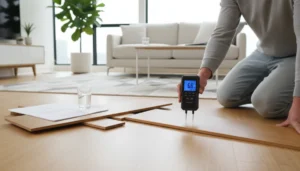
To maintain the highest quality standards, we rely on specialized equipment to verify moisture levels. If you are wondering do bamboo board need to be test for humidity, the answer is a definitive yes, and using the right technology is the only way to get accurate data. Relying on guesswork leads to warping and structural failure, so I always recommend professional-grade tools for every stage of production and installation.
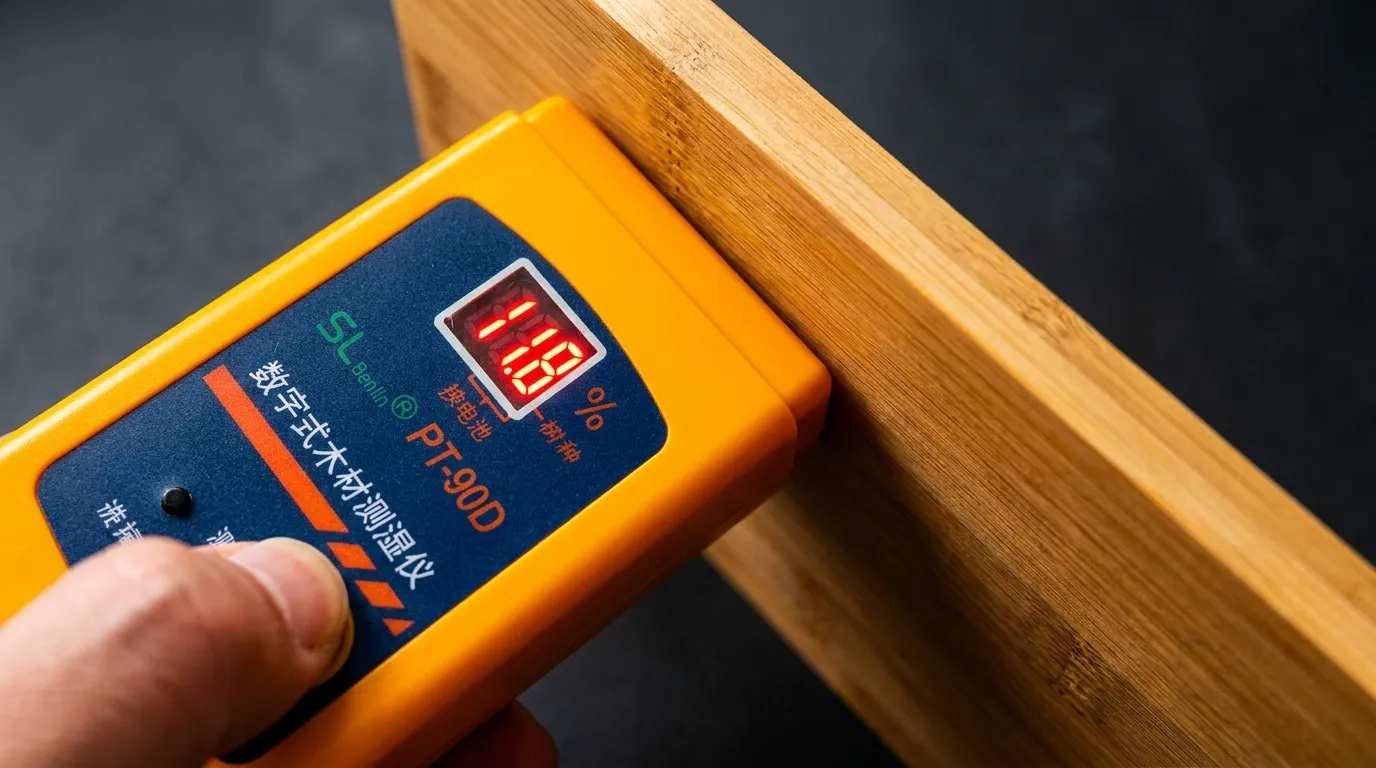
Pin Moisture Meters
Pin-type meters are the industry standard for getting deep, localized readings. These devices feature two metal probes that physically penetrate the bamboo fibers to measure electrical resistance.
- Accuracy: Provides a precise reading of the moisture content at a specific depth.
- Best Use: Ideal for checking raw lumber or thick bamboo planks where core moisture is a concern.
- Note: Because they leave small \”pinholes,\” I suggest using them on the underside or edges of the boards to keep the visible surface pristine.
Pinless Moisture Meters
When I need to check finished products without damaging the surface, pinless meters are the superior choice. These use electromagnetic signals to scan the material.
- Non-Destructive: They leave no marks, making them perfect for inspecting a bamboo food tray wholesale or high-end flooring.
- Speed: You can quickly scan large surface areas to find \”wet spots\” that a pin meter might miss.
- Calibration: Ensure the meter is set to the correct density for bamboo, as its specific gravity differs from traditional hardwoods.
Thermo-Hygrometers for Environmental Monitoring
Measuring the board is only half the battle; you also need to measure the air. Thermo-hygrometers track the ambient temperature and relative humidity (RH) of the storage or installation site.
- Equilibrium Moisture Content (EMC): These tools help determine if the bamboo has reached a stable state relative to its environment.
- Prevention: Monitoring the job site ensures a bamboo charcuterie board set or decking material won\’t undergo rapid moisture shock once unpacked.
- Consistency: Keeping a log of environmental data is a professional way to troubleshoot any future stability issues.
Installation and Maintenance Practices for Moisture Control
As a dedicated bamboo products manufacturer and supplier, clients frequently ask us: do bamboo board need to be test for humidity? The answer is a definitive yes. However, factory testing is just the starting point. How you install and maintain the bamboo dictates how well it handles moisture over its lifespan.
Proper Board Acclimation and Conditioning
Before any installation begins, bamboo boards must adapt to the specific climate of the room. Skipping this step leads to immediate warping or gapping.
- Acclimate on-site: Keep the bamboo in the actual installation room for 48 to 72 hours before starting work.
- Open the packaging: Break the seals on the boxes to let the air circulate around the boards.
- Maintain ideal conditions: Ensure the room\’s HVAC system is running, keeping the relative humidity consistently between 40% and 60%.
Installation Techniques for Proper Drainage and Ventilation
Trapped moisture destroys natural materials. Proper installation techniques ensure that humidity and direct water exposure do not compromise the structure.
- Leave expansion gaps: Always leave a 1/4-inch to 1/2-inch gap around the perimeter of the room. Bamboo naturally expands and contracts with seasonal humidity changes.
- Install moisture barriers: When laying bamboo over a concrete subfloor, a high-quality vapor barrier underlayment is mandatory to block ground moisture.
- Promote airflow: For bamboo used in wet environments, design matters. For instance, the slatted base of our bamboo 2-tier corner shower shelf for bathroom is specifically engineered to allow rapid water drainage and constant ventilation, preventing water from pooling.
Long-Term Maintenance and Surface Protection
Protecting your bamboo investment requires simple, consistent surface care. Even bamboo products exposed directly to water, like a wholesale knife sharpening stone with bamboo holder, rely on a combination of factory sealing and proper user maintenance to resist waterlogging.
Daily and Seasonal Maintenance Checklist:
- Dry cleaning only: Sweep or vacuum regularly. If you must mop, use a barely damp microfiber cloth. Never wet-mop bamboo.
- Manage spills instantly: Wipe up standing water or dropped liquids immediately to prevent absorption into the wood fibers.
- Climate control: Use a humidifier during dry winter months to prevent shrinking, and run a dehumidifier or air conditioner during humid summers to prevent swelling.
- Renew protective finishes: Over time, surface wear reduces moisture resistance. Periodically re-apply a compatible sealant, wax, or polyurethane finish to keep the moisture shield intact.

Celia
Celia is a bamboo product manufacturing expert dedicated to green innovation and sustainable supply chain solutions. With over 10 years of industry experience, he helps global businesses build premium private-label eco products. Outside of work, he is an avid nature explorer.
Frequently Asked Questions

Get a Fast, Custom Bamboo Quote