Do Bamboo Plant Need Sun Light ? – Jibamboo
Do Bamboo Plants Need Sun? Understanding Light Requirements
Bamboo plants are highly adaptable, but their success depends heavily on light exposure. While most species are sun-loving, the intensity and duration of light required can differ significantly between indoor and outdoor settings. To ensure healthy growth, you must match the specific bamboo variety to the light conditions of your space.
Direct Sunlight vs. Indirect Light
The distinction between direct and indirect light is critical for bamboo health. Outdoor timber bamboo typically thrives in direct sunlight, which fuels the photosynthesis needed for its aggressive growth patterns and thick culms. Conversely, many indoor species or smaller groundcover bamboos prefer bright, indirect light. Direct rays through a window can often be too intense for indoor varieties, leading to leaf burn and dehydration.
How Many Hours of Sun Does Bamboo Need Daily?
For optimal health and vibrant green foliage, most bamboo plants require a specific duration of light exposure daily:
| Light Category | Daily Duration | Best Suited For |
|---|---|---|
| Full Sun | 6+ Hours | Large timber bamboo and privacy screening varieties |
| Partial Sun | 4-6 Hours | Most clumping bamboos and mid-sized garden species |
| Low Light | Less than 4 Hours | Specific shade-tolerant varieties and indoor decorative plants |
Can Bamboo Grow in Full Shade?
While bamboo is resilient, very few species thrive in full shade. Most will survive, but they will not reach their full potential. In low light conditions, you will notice specific growth issues:
- Slower Growth Rates: The plant lacks the energy to produce new culms or runners.
- Leggy Appearance: Stems become thin and stretch excessively toward the nearest light source.
- Sparse Foliage: Leaves become thinner, lose their luster, and may turn a pale green.
For those dealing with deep shade, selecting a specific shade-tolerant variety is the only way to maintain a lush, healthy look.
Sun Requirements for Different Bamboo Varieties
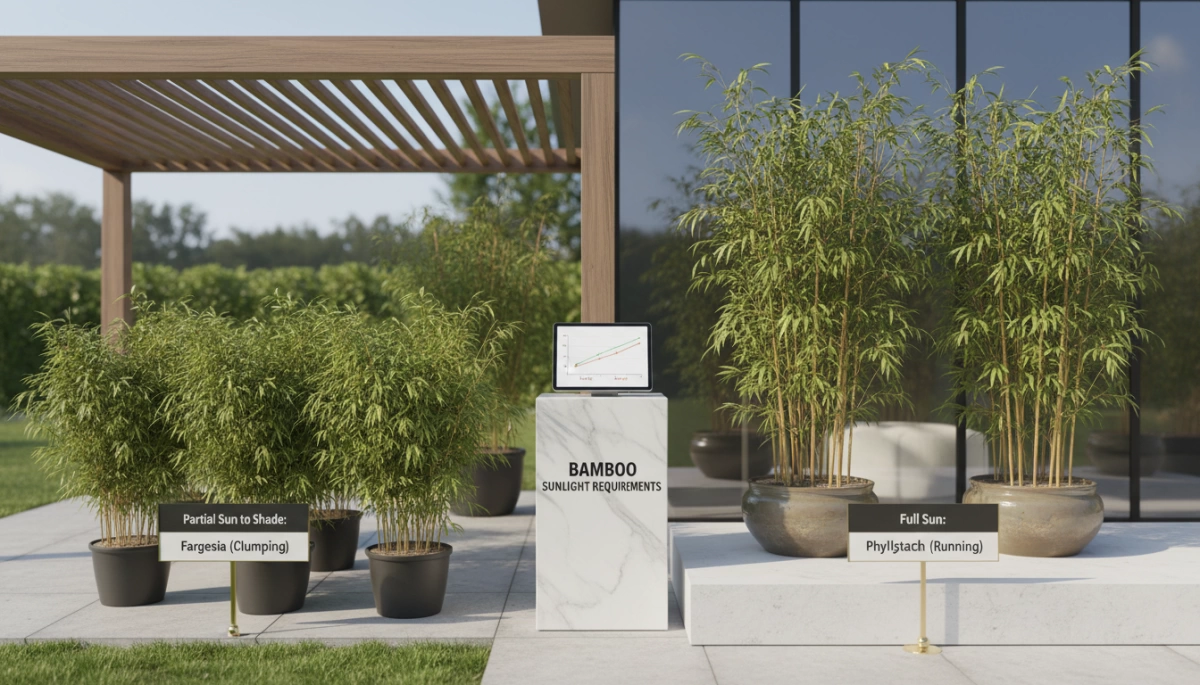
As a long-term Bamboo products Manufacturer and Supplier, I have observed that the quality of the raw material is directly tied to how much sunlight the plant receives during its growth cycle. Different species have evolved to thrive in specific light levels, ranging from the scorching open plains to the filtered light of a forest canopy.
Full Sun Bamboo Species for Outdoor Landscapes
Most large-scale timber bamboos require full sun to reach their maximum height and culm thickness. These species use intense photosynthesis to fuel their aggressive growth. If you are planting for privacy or timber, these varieties need at least 6 to 8 hours of direct exposure.
- Phyllostachys edulis (Moso): Requires maximum sun to develop its massive diameter.
- Phyllostachys aurea (Golden Bamboo): The \”golden\” hue actually intensifies with more direct sunlight.
- Bambusa oldhamii: Thrives in hot, sunny climates and reaches impressive heights.
Shade-Tolerant Bamboo Varieties
If your garden has low light conditions, you should opt for mountain-dwelling species. These plants naturally grow under the canopy of larger trees and can suffer from leaf burn if exposed to intense midday sun.
- Fargesia species: These are the most popular shade-tolerant clumpers.
- Thamnocalamus: Prefers cool, shady spots and consistent moisture.
- Sasa: Often used as a groundcover in areas where other plants fail due to lack of light.
Light Needs for Clumping vs. Running Bamboo
While there are exceptions, the growth habit of the bamboo often dictates its light preference. Running bamboos are generally more sun-hungry, while many clumping varieties appreciate protection from the afternoon heat. The high-quality fibers harvested from sun-drenched groves are what allow us to produce durable goods, such as a natural bamboo detangling hair brush set, which relies on the strength of well-matured culms.
| Bamboo Type | Preferred Light | Best Environment |
|---|---|---|
| Running Bamboo | Full Sun to Partial Shade | Large open landscapes, barriers |
| Clumping Bamboo | Partial Shade to Filtered Light | Residential gardens, pots |
| Timber Bamboo | 6+ Hours Direct Sun | Commercial groves, large estates |
| Groundcover Bamboo | Full Shade to Partial Sun | Understory planting, erosion control |
Understanding these specific needs ensures the plant remains vibrant and the wood stays strong for future use in manufacturing. Most \”running\” types will become stunted and thin if they do not get enough sun, while \”clumping\” types may yellow and drop leaves if the sun is too intense.
Growing Bamboo Indoors: Light and Placement Tips
When you bring bamboo inside, the most common question I hear is, do bamboo plant need sun to survive in a living room or office? The answer is a firm yes. While bamboo is adaptable, it is not a \”no-light\” plant. Indoor environments often lack the intensity of the natural sky, so strategic placement is the only way to keep the foliage vibrant and prevent the stalks from weakening.
Best Indoor Locations for Natural Light
To ensure your bamboo gets enough energy, place it near an East-facing or South-facing window. These spots provide the bright, filtered light that indoor bamboo craves.
- East-facing windows: Provide gentle morning sun that won\’t scorch the leaves.
- South-facing windows: Offer the strongest light; I recommend using a sheer curtain to diffuse the rays so the plant doesn\’t get hit by harsh, direct sunlight.
- Distance matters: Keep the plant within 3 to 5 feet of the window. Moving it further into a dark corner often leads to yellowing leaves and stunted growth.
Using Artificial Grow Lights for Indoor Bamboo
If your space suffers from low light conditions, natural windows might not be enough. In these cases, you must supplement with artificial lighting.
- Full-spectrum LED grow lights are the most effective choice. They mimic the sun\’s natural spectrum without producing excessive heat.
- Duration: Keep grow lights on for 10–12 hours a day to simulate a natural day-night cycle.
- Placement: Position the light about 12–24 inches above the canopy to prevent heat stress while ensuring the lower leaves still receive energy.
Managing Temperature and Humidity Indoors
Proper lighting is only half the battle; the indoor climate must also be right. Bamboo is sensitive to the dry air often found in climate-controlled homes.
- Avoid Drafts: Never place your bamboo directly in front of air conditioning vents or heating radiators. Rapid temperature swings can cause leaf drop.
- Humidity is Key: Since indoor air is drier than the outdoors, use a pebble tray or a humidifier to keep the moisture levels around 50% or higher.
- Consistent Temps: Aim for a steady range between 65°F and 80°F. If you are comfortable in the room, your bamboo likely is too.
Special Case: Light Requirements for Lucky Bamboo
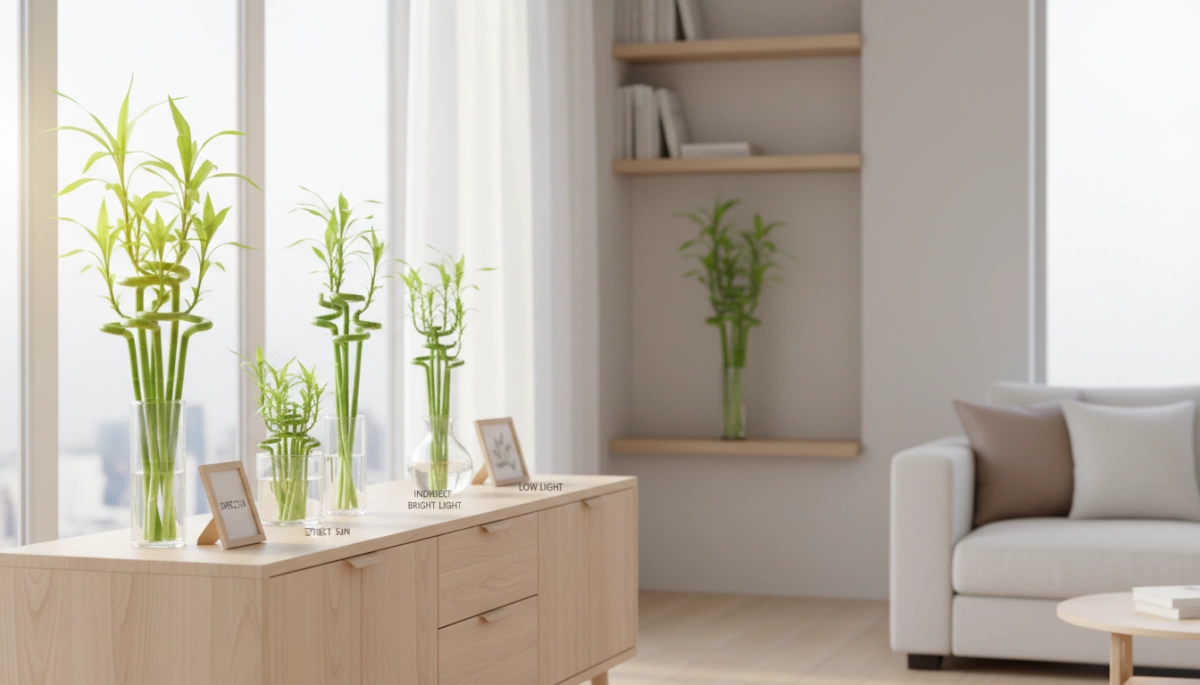
Lucky bamboo is a popular choice for home and office decor, but its light needs differ significantly from true timber bamboo. While many wonder \”do bamboo plants need sun,\” lucky bamboo actually thrives in much lower light levels than its outdoor cousins.
Why Lucky Bamboo Prefers Low to Indirect Light
Lucky bamboo is naturally an understory plant, meaning it grows beneath the canopy of taller trees. It is evolved to filter sunlight through leaves rather than taking the full force of the sun. In a home setting, bright, indirect light is the gold standard. Placing your plant near a north-facing window or a few feet away from a sunny window ensures it gets enough energy to stay green without being overwhelmed.
Risks of Placing Lucky Bamboo in Direct Sunlight
Direct sunlight is the quickest way to damage this plant. Because it is often grown in water rather than soil, high light levels create a dual problem: leaf scorch and water issues.
- Leaf Scorch: The leaves will quickly turn yellow or develop brown, crispy patches.
- Algae Growth: Direct sun hitting a glass vase encourages rapid algae growth, which competes with the plant for nutrients.
- Water Temperature: Sunlight can overheat the water, essentially \”cooking\” the delicate root system.
| Light Level | Effect on Lucky Bamboo |
|---|---|
| Direct Sun | Causes yellowing, sunburn, and root damage. |
| Bright Indirect | Ideal for fast growth and vibrant green color. |
| Low Light | Slows growth but keeps the plant healthy. |
| Total Darkness | Leads to spindly, weak stems and eventual death. |
Growing Lucky Bamboo in Low-Light Rooms
One of the best features of lucky bamboo is its ability to survive in low-light conditions where other plants might fail. It is a perfect companion for a 3-tier bamboo drawer storage organizer on a desk or a bathroom vanity. Even if your room has no large windows, lucky bamboo can often pull enough energy from standard overhead office lighting to maintain its health.
If you notice the plant becoming \”leggy\”—meaning the stems are stretching out with very few leaves—it is a sign it needs just a bit more light. Simply move it closer to a light source for a few hours a day to restore its compact, lush appearance. Keeping the environment organized with high-quality bamboo products creates a clean aesthetic that complements the minimalist look of lucky bamboo perfectly.
Signs Your Bamboo Plant Is Getting Too Much or Too Little Sun
Monitoring your bamboo’s appearance is the best way to determine if its current environment is ideal. While you might wonder, do bamboo plant need sun to thrive, the answer is a balance; too much or too little light will trigger specific physical reactions in the plant.
Symptoms of Sunburn and Heat Stress
When a bamboo species that prefers shade is forced into intense, direct exposure, it will show signs of distress. If you notice the following, your plant is likely suffering from sunburn:
- Bleached Leaves: Foliage turns a pale yellow or white, losing its vibrant green pigment.
- Crispy Edges: The tips and margins of the leaves become brown, dry, and brittle.
- Leaf Curling: Bamboo often curls its leaves inward to reduce the surface area exposed to the sun and conserve moisture.
- Rapid Dehydration: The soil dries out significantly faster than usual, leading to wilted culms.
Identifying Light Deficiency and Leggy Growth
On the flip side, low light conditions can starve the plant of the energy it needs for photosynthesis. If your bamboo isn\’t getting enough light, it will prioritize height over health. Watch for these indicators:
- Leggy Growth: The plant develops long, weak stems with large gaps between the leaf nodes as it \”stretches\” toward the nearest light source.
- Pale Foliage: New leaves emerge as a dull, light green rather than a deep, healthy hue.
- Slowed Development: A complete lack of new shoots or significantly stunted growth during the peak growing season.
- Leaning: The entire plant begins to tilt aggressively toward a window or light source.
How to Acclimate Bamboo to New Light Conditions
You cannot move a bamboo plant from a dark corner directly into the afternoon sun without causing shock. To properly adjust your plant, follow a gradual transition:
- The Week One Rule: Move the plant to its new location for just one to two hours a day, then return it to its original spot.
- Incremental Exposure: Increase the time spent in the new light by one hour every two days.
- Monitor Moisture: During the transition, check the soil daily. Increased light usually means the plant will require more frequent watering to stay hydrated.
- Observe the Leaves: If you see any curling or spotting during the process, move it back a step and slow down the transition.
Properly managing these transitions ensures your bamboo remains as resilient as the raw materials we use to create a high-quality bamboo laundry basket wholesale or other durable home goods. Consistent light levels result in the strongest, most aesthetically pleasing stalks.

Essential Care Tips to Complement Proper Lighting
While answering the question do bamboo plant need sun is the first step, light alone won\’t guarantee a thriving plant. As a bamboo products manufacturer, I’ve seen that the best results come from a holistic approach where light, water, and nutrients work in harmony.
Watering and Soil Moisture Balance
Bamboo is a thirsty plant, but it cannot sit in stagnant water. The amount of hydration required often depends on the light exposure:
- High Light Areas: If your bamboo is in direct sunlight, it will transpire quickly. Check the soil daily and water when the top inch feels dry.
- Low Light Conditions: For indoor bamboo or shade-tolerant varieties, the soil stays damp longer. Overwatering in these areas leads to root rot.
- Drainage: Always use well-draining soil. If you are growing in containers, ensure there are plenty of drainage holes. To keep your gardening area tidy after maintenance, using a mini bamboo pot brush helps clean off soil residue from your ceramic or bamboo planters without scratching the surface.
Fertilizing for Healthy Foliage
To maintain that iconic vibrant green color, bamboo needs a steady supply of nutrients. Since bamboo is technically a grass, it thrives on nitrogen-rich fertilizers.
- Timing: Apply a balanced, slow-release fertilizer in early spring and again in mid-summer.
- Organic Options: Compost or well-rotted manure works wonders for outdoor groves.
- Indoor Care: For indoor plants, use a diluted liquid fertilizer once a month during the growing season. Avoid fertilizing in winter when the plant\’s metabolism slows down.
Pruning and Maintenance for Optimal Growth
Pruning is essential to keep your bamboo from becoming a tangled mess and to ensure light reaches the inner culms. Even if you provide the perfect amount of sunlight, a dense canopy can shade out the base of the plant.
- Thinning: Every year, remove older, yellowing culms at ground level. This directs energy to new, vigorous shoots.
- Topping: If your bamboo is getting too tall for its space, you can \”top\” it by cutting just above a node. This encourages the plant to fill out laterally.
- Cleaning: Keep the leaves free of dust, especially for indoor plants. Clean leaves absorb sunlight more efficiently, which is vital if your plant is situated in a spot with limited natural light.
Frequently Asked Questions

Get a Fast, Custom Bamboo Quote