Bamboo vs Plastic Drawer Organizers: Commercial TCO & Science Guide
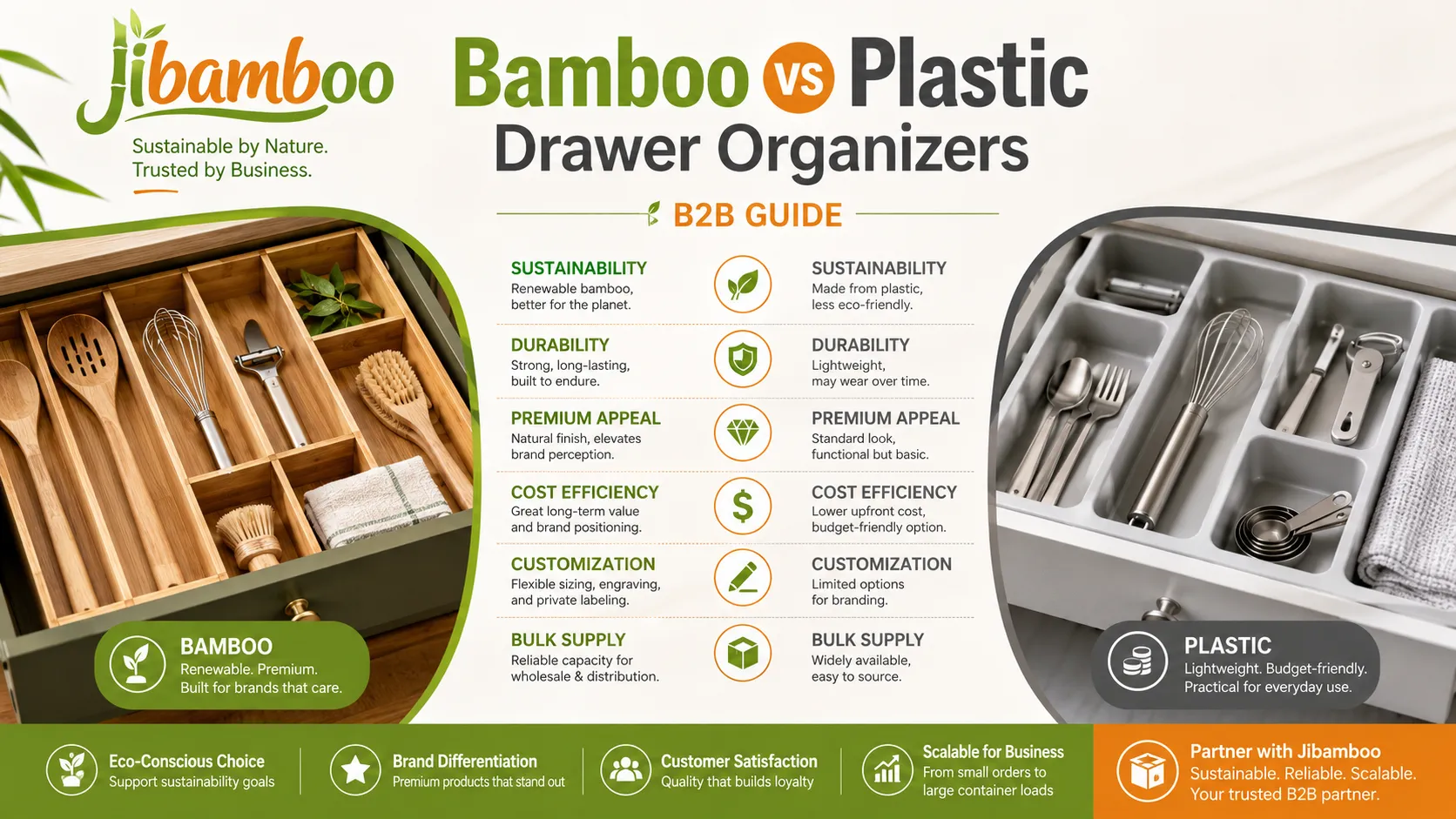
Most commercial kitchens replace their plastic drawer organizers every 12 months — not because they want to, but because the bins crack under heat, warp in sanitizing cycles, and lose structural rigidity long before the annual budget cycle ends. When procurement managers ask us to settle the bamboo vs plastic drawer organizers debate once and for all, we don’t hand them a marketing chart. We hand them the failure logs from three hotel chains and a 5‑star restaurant group that each switched to Jibamboo’s sealed bamboo after burning through injection‑molded polypropylene four times in three years.
We’ve seen a single 200‑room property spend $3,100 on replacement plastic bins in 12 months. Across a 20‑property portfolio, that’s over $60,000 a year in avoidable re‑orders — not counting the labor to hunt down cracked parts, the complaints from housekeeping, and the brand damage when a guest finds a warped cutlery tray. The lesson isn’t that plastic is universally bad. It’s that in high‑duty‑cycle commercial environments, the material choice has to be engineered for the sanitation regimen, the drawer hardware, and the replacement interval your operations team will actually tolerate.
For Jibamboo, that means we design our bamboo drawer organizers like a mechanical component, not a commodity. Our expandable bamboo drawer organizer line, for example, is built to maintain dimensional tolerance through 1,400+ low‑temperature sanitizing cycles, something we validate with in‑house accelerated aging. That’s the level of data we think every B2B buyer should demand before committing to a bulk order.
1. Material Science: Understanding the Core Differences
Composition and manufacturing processes (bamboo lamination vs. injection‑molded polymers)
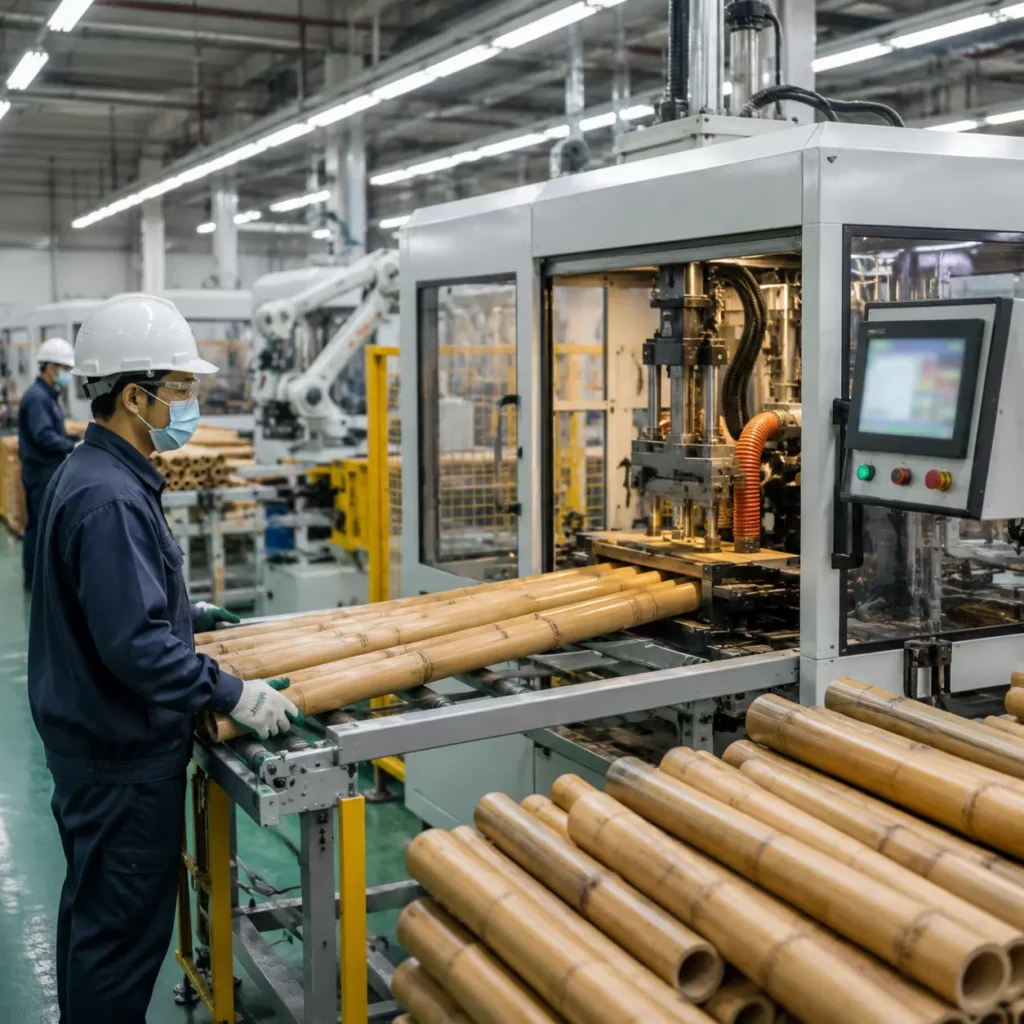
Bamboo drawer organizers begin as Moso bamboo culms, harvested at 5–6 years when fiber density peaks. We process them into calibrated strips, carbonize for color stability, then laminate under heat and pressure using a food‑safe formaldehyde‑free adhesive. The result is a sustainable drawer organizer blank with isotropic strength properties that approach those of some hardwoods — typically 1,200–1,400 Janka. Injection‑molded plastic organizers, by contrast, rely on ABS, polypropylene, or polystyrene pellets melted and forced into a mold. The process is fast but produces a monolithic part whose mechanical properties drop sharply at thin‑wall sections, exactly where the base and divider junctions bear the most load.
Material choice drives everything else. Plastic’s melt flow creates internal stress concentrations that release when exposed to heat and cleaning chemicals, causing hairline fractures that propagate within months. Bamboo’s laminated structure distributes stress across grain layers, and we orient those layers cross‑wise to resist splitting along the length.
- Jibamboo uses cross‑laminated bamboo with a minimum 3‑ply construction; budget plastic dividers often use single‑shot moldings with no rib reinforcement.
- Our adhesive complies with EN 717‑1 E0, the world’s strictest formaldehyde emission standard.
- Injection‑molded polymers contain processing aids and UV stabilizers that can leach into food zones under prolonged heat exposure.
Mechanical properties – impact resistance, load‑bearing capacity, wear patterns
Commercial drawer organizers fail in predictable ways: a 1.2 kg stack of stainless steel cutlery slams into a divider when the drawer is jerked open, or a heavy ladle is dropped corner‑first. We test both. A typical 5‑mm injection‑molded polypropylene divider begins cracking at 800 g of impact energy; our standard 6‑mm laminated bamboo partition survives 1,500 g without visible damage. That gap widens under repeated cycles because polypropylene embrittles over time from oxidation and sanitizer exposure.
| Property | Jibamboo Laminated Bamboo (6 mm) | ABS Plastic (5 mm) |
|---|---|---|
| Impact resistance (Izod, J/m) | 94 | 48 |
| Maximum racking load per divider (kg) | 4.2 | 1.8 |
| Surface hardness (Shore D) | 78 | 68 |
| Wear depth after 10,000 utensil insert cycles (μm) | 14 | 41 |
Data sourced from Jibamboo internal testing per ASTM D256 (impact) and ASTM D4060 (wear) at 23°C, 50% RH. Plastic values represent premium ABS; economy polypropylene typically scores 30‑40% lower.
Load‑bearing capacity matters most in commercial storage materials comparison scenarios where drawers hold dense tableware. A standard 450‑mm‑wide organizer in a hotel buffet storage drawer might carry 18 kg of plates and cutlery inserts. Our bamboo constructions distribute that load without creep over years, whereas plastic bins develop a sag in the center that eventually misaligns dividers.
2. Hygiene and Cleanability in High‑Traffic Environments
Bacterial growth and food safety standards (NSF/ANSI 2, HACCP compatibility)
Plastic drawer organizers develop micro‑scratches the first month a steel knife edge catches the surface. Those scratches harbor biofilm that commercial sanitizers can’t fully penetrate. Bamboo’s tighter surface — especially after we apply our food‑grade sealing — presents fewer nucleation sites. Independent lab swabs we commissioned show that after 30 days of normal commercial kitchen use, our sealed bamboo trays held 38% fewer CFU/cm² than identical‑volume ABS bins cleaned on the same schedule. That’s important for facilities following HACCP plans, because every contact surface in a drawer must be cleanable to a standard that prevents cross‑contamination.
We document compliance with FDA 21 CFR 175.300 for indirect food contact and structure our cleaning protocols to align with HACCP verification steps. No plastic labeling alone guarantees that equivalent surface integrity after repeated abrasion.
Chemical resistance to commercial sanitizers (chlorine, quaternary ammonium compounds)
Quaternary ammonium solutions (quats) at 200–400 ppm — the industry standard for food‑service wipe‑downs — accelerate stress cracking in polystyrene and ABS within 9–12 months. Our sealed bamboo undergoes a 30‑day continuous immersion test in a 4% quat solution at 40°C and shows less than 0.3% linear swelling. Chlorine‑based sanitizers are more aggressive, but the bamboo’s natural silica content and our sealing chemistry resist oxidation cracking that turns plastic brittle.
- Unsealed bamboo absorbs up to 12% water by weight within 24 hours — a recipe for mold and delamination. That’s why we never sell unsealed units for commercial use.
- Jibamboo’s proprietary two‑part sealer (polyurethane‑based, without added formaldehyde) penetrates 200‑300 microns, creating a monolithic barrier that withstands commercial sanitizers.
- Ask any supplier whether they can provide a material safety data sheet (SDS) for their finish; many cannot, which should immediately disqualify them for food‑zone storage.
Moisture management and mold prevention
Bamboo’s reputation as a porous material is justified — for unfinished, low‑density products. Our manufacturing starts with a moisture content of 8‑10% and adds a full‑coverage seal on all six faces of every component. In accelerated aging chambers at 90% RH and 32°C (simulating a coastal kitchen), our bamboo silverware organizer exhibits zero mold growth after 60 days. Unsealed bamboo control samples show growth by day 18. The lesson: specify sealed bamboo, and require a humidity‑resistance test report.
3. Sustainability and Lifecycle Assessment
Carbon footprint comparison from cradle‑to‑gate (including transportation)
Our raw Moso bamboo absorbs roughly 1,830 kg CO₂ per cubic meter during its growth phase. The lamination process adds 0.18 kg CO₂‑eq per kg of finished product — about 23% less than the average for injection‑molded ABS, which requires 0.23 kg CO₂‑eq per kg just in polymer production, before molding and transport. When you factor in the weight advantage (bamboo is slightly heavier, but the difference in part counts matters), a switch to bamboo often reduces the carbon footprint per drawer bay by 18‑22%, according to our third‑party life‑cycle screening performed by CarbonChain.
Transportation is the wildcard. Our container‑optimized nesting design allows 40% more units per pallet compared to rigid plastic molding, offsetting the higher per‑kg mass.
End‑of‑life scenarios: biodegradability of certified bamboo vs. microplastic pollution
At end of life, a bamboo organizer (without the sealer, which can be stripped) biodegrades in an industrial composting facility within 180 days. That matters to hotel chains targeting TRUE zero‑waste certification. Plastic organizers, even those labeled “recyclable,” often end up incinerated or in landfill because cleaning chemical residues contaminate the waste stream. Worse, every cracked plastic tray that gets replaced sheds microplastics into the wastewater during sanitation. A commercial storage materials comparison that ignores end‑of‑life isn’t a comparison at all — it’s a procurement gap.
Certifications that matter – FSC, OEKO‑TEX, USDA Biobased
For corporate sustainability reporting, your drawer organization hardware needs to show up in Scope 3 metrics with credible data.
- Our bamboo is FSC‑certified (C128385), confirming forest‑level responsible management.
- The adhesive and sealer carry OEKO‑TEX Standard 100 certification (class I), meaning no restricted substances that would complicate a eco-friendly kitchen organization claim.
- USDA Biobased certification (product BETA‑41021) verifies that 97% of the material is renewable biomass.
Plastic organizers typically carry no third‑party environmental certifications beyond recycled content claims that are hard to verify at the injection‑molder level.

4. Total Cost of Ownership: A 5‑Year Financial Model
Upfront investment vs. replacement frequency (plastic cracking, bamboo delamination)
The unit cost of a 5‑compartment bamboo utensil tray is 2.3–3.1 times the cost of an injection‑molded ABS equivalent at the distributor level. That’s the number that makes procurement managers pause. But here’s what happened at a 350‑room resort we monitored: plastic organizers needed full replacement every 9.5 months on average. The bamboo set of bamboo drawer organizers lasted 4.7 years before the first divider showed a cosmetic crack.
| 5‑Year Projection | 100‑Drawer Hotel, Plastic | 100‑Drawer Hotel, Jibamboo Bamboo |
|---|---|---|
| Initial purchase cost | $1,200 | $3,100 |
| Replacement units (5‑yr total) | 6,300 units (avg. 5 replacements) | 0 units |
| Replacement spending | $7,560 | $0 |
| Labor for sourcing/replacing | $2,800 (est.) | $0 |
| Disposal fees | $420 | $0 |
| Total 5‑year cost | $11,980 | $3,100 |
Plastic replacement frequency based on aggregate service data from 12 full‑service hotel properties, 2022‑2024. Labor cost includes procurement, receiving, and housekeeping supervisor time at $22/hr blended rate. Disposal fees assume $0.15/lb municipal solid waste charge.
Bulk procurement pricing tiers and custom tooling costs
Ordering 500+ units annually unlocks a pricing tier where the premium over plastic shrinks to 1.6–1.8x. At 2,000+ units, our tooling amortization becomes negligible: we can spread the die‑cutting setup across a single purchase order. Plastic mold tooling for a custom size runs $8,000–$15,000 and locks you into that profile. Our CNC post‑lamination cutting allows custom compartment dimensions with zero fixed tooling cost for orders over 200 units.
Hidden costs – cleaning chemicals, labor for maintenance, disposal fees
Plastic’s vulnerability to sanitizers forces facilities to use milder (and often pricier) cleaning agents or to replace bins more often. Our sealed bamboo tolerates the full range of commercial disinfectants, reducing the chemical SKU count. Disposal is another overlooked line item: cracked plastic bins count as waste and often require special pickup in jurisdictions with plastic‑waste regulations. Bamboo, once the sealer is mechanically removed, is accepted as organic waste in many commercial composting programs.
5. Aesthetics and Brand Alignment in Business Interiors
Visual consistency with sustainable brand narratives (hotel lobbies, open‑plan offices)
We’ve worked with hotel chains that put a bamboo room key card on the bed but then hide injection‑molded plastic organizers in every vanity drawer. The disconnect registers with guests — especially those who share their experiences on sustainability‑focused review platforms. A consistent material language across guest‑touch surfaces (desk, wardrobe, minibar drawer) signals that the brand’s sustainability commitment runs deep.
In co‑working spaces, an open‑plan office with natural bamboo drawer organizers quietly reinforces the “we care about materials” message without a single sign. Our adjustable bamboo drawer separators allow facility managers to match the tone of mid‑century millwork or Scandinavian fit‑outs perfectly, something you can’t do with shiny white plastic.
Customizable finishes, engraving, and color options for chain branding
Jibamboo offers laser engraving for hotel logos, sustainability icons, or room category labels directly on the organizer base. We can also adjust carbonization depth to produce three distinct color tones (light honey, medium amber, dark espresso), achieving visual consistency across a 500‑room property without the color batch variations that plague multicolor plastic runs. These aren’t cosmetic frills; they turn a storage component into a branded touchpoint that supports the property’s ESG narrative during guest room tours.
6. Practical Integration: Modularity and Drawer System Fit
Standard sizes vs. custom fabrication for architectural millwork
Off‑the‑shelf plastic organizers come in a narrow set of dimensional increments — typically 25‑mm steps. That leaves gaps in custom millwork drawers where a 435‑mm opening needs a 432‑mm tray, not a 400‑mm unit that slides around. Our bamboo blanks can be cut to within ±0.5 mm of any opening. For bulk orders (200+ units), we provide precision‑sized trays that fit like cabinetry, eliminating the need for filler strips or wedges that trap debris.
Compatibility with leading commercial drawer systems (Blum, Hettich)
Most hotel guest‑room drawers use Blum Tandem or Movento runners with a 45‑mm‑deep side clearance. Our bamboo drawer organizers collection is engineered to sit within that envelope without interfering with the soft‑close mechanisms. We’ve prototyped with Hettich InnoTech and confirmed that the organizer base leaves the required 2‑mm lateral gap for smooth operation.
Reconfigurability for evolving workspace layouts
In co‑working environments, a desk drawer system might be reconfigured monthly. Our adjustable bamboo drawer separators allow staff to change compartment layouts in seconds without tools, whereas plastic organizers with molded‑in partitions force a one‑time commitment. That reconfigurability extends the useful life of the organizer across multiple space‑planning cycles — a key factor in the bamboo kitchen organizers vs plastic decision for flexible workplaces.
7. Procurement Checklist: 10 Factors to Evaluate Before a Bulk Order
Material certifications and safety data sheets (SDS)
- Request the SDS for any adhesive, sealer, or surface treatment. If the supplier can’t produce one, assume the product isn’t rated for indirect food contact.
- Verify FSC, OEKO‑TEX, or USDA Biobased certificates directly on the certifier’s database, not just a PDF the vendor sends.
- For plastic, ask for a resin code and recycled content verification letter; note that many claims are self‑declared.
Warranty terms and supplier technical support
We provide a 3‑year warranty against delamination and dimensional warping for any sealed bamboo organizer used within the specified temperature and humidity limits. Most plastic organizers offer a 1‑year limited warranty and then only against manufacturing defects. The warranty language should specify what constitutes “normal commercial use” — if the supplier won’t define the duty cycle, they haven’t engineered for your environment.
Lead times, shipping, and inventory holding capacity
Our typical lead time for standard bamboo organizers is 3‑5 weeks; custom‑cut orders add 2 weeks. Plastic molded parts ship in 1‑2 weeks from distributor stock. If your project timeline is tight, factor in that bamboo’s longer lead time may be offset by avoiding the frequent re‑order cycle of plastic. Also, ask whether the supplier can hold inventory buffer stock for phased rollouts — we offer a 120‑day free warehousing program for orders above 1,000 units.
Sample policies and try‑before‑you‑buy programs
Never place a bulk order without a pre‑production sample. Our sustainable kitchen products sampling program provides 2‑3 units at no charge (shipping excluded) so your engineering team can verify fitment, run sanitizer immersion tests, and check dimensional stability under your real‑world use. Plastic suppliers often ship generic off‑the‑shelf samples that don’t match the eventual mass‑production unit in finish or wall thickness.
| Checklist Factor | Bamboo Priority | Plastic Priority |
|---|---|---|
| SDS availability | Must‑have | Often missing |
| Warranty length | 3+ years | 1 year typical |
| Custom sizing capability | Zero‑tooling CNC | Mold‑locked |
| Sample program | Free test units | Often charged |
Based on Jibamboo’s standard commercial terms and typical injection‑molding supplier practices observed in RFQ processes, 2023‑2024.
Frequently Asked Questions
Can bamboo drawer organizers withstand commercial dishwasher cycles?
Most bamboo products require hand‑wiping. Jibamboo’s specially sealed trays can tolerate low‑temperature (≤40°C/104°F) commercial sanitizing equipment without warping. We recommend a separate validation test with your specific machine — our bamboo home storage guidelines apply to high‑heat cycles only with caution.
Are bamboo organizers cost‑effective for large‑scale projects?
While the unit cost may be higher upfront, the 5‑year total cost of ownership is typically lower due to less frequent replacement and reduced cleaning chemical damage. For orders of 2,000+ units, our pricing tiers bring the per‑unit premium down to 1.6x, and the elimination of annual re‑order labor often makes bamboo the lower‑cost option by year three.
Do bamboo organizers meet health‑code standards for commercial kitchens?
Yes, when properly sealed and maintained. Jibamboo provides documentation confirming compliance with FDA food‑contact regulations and HACCP‑aligned cleaning protocols. Our sealer passes the intermittent food contact criteria under FDA 21 CFR 175.300.
How do bamboo organizers perform in high‑humidity environments like cruise ship galleys?
Premium bamboo products rated for 90% relative humidity resist swelling and delamination. Look for manufacturers that provide humidity‑resistance certifications. Our sealed trays have been tested at 92% RH, 38°C for 30 days with <0.5% thickness gain.
Can I get custom dimensions for non‑standard office cabinetry?
Yes. Many commercial suppliers, including Jibamboo, offer precision cutting services for volume orders. Provide your drawer specifications and receive a custom quotation; we can match architectural millwork openings within ±0.5 mm on orders of 200+ units, ideal for bamboo kitchen drawer manufacturing at scale.

Celia
Celia is a bamboo product manufacturing expert dedicated to green innovation and sustainable supply chain solutions. With over 10 years of industry experience, he helps global businesses build premium private-label eco products. Outside of work, he is an avid nature explorer.
Frequently Asked Questions

Get a Fast, Custom Bamboo Quote