Commercial Grade Bamboo Cutting Board Durability for Chefs – Jibamboo
The Commercial Kitchen Stress Test: Why Durability Matters
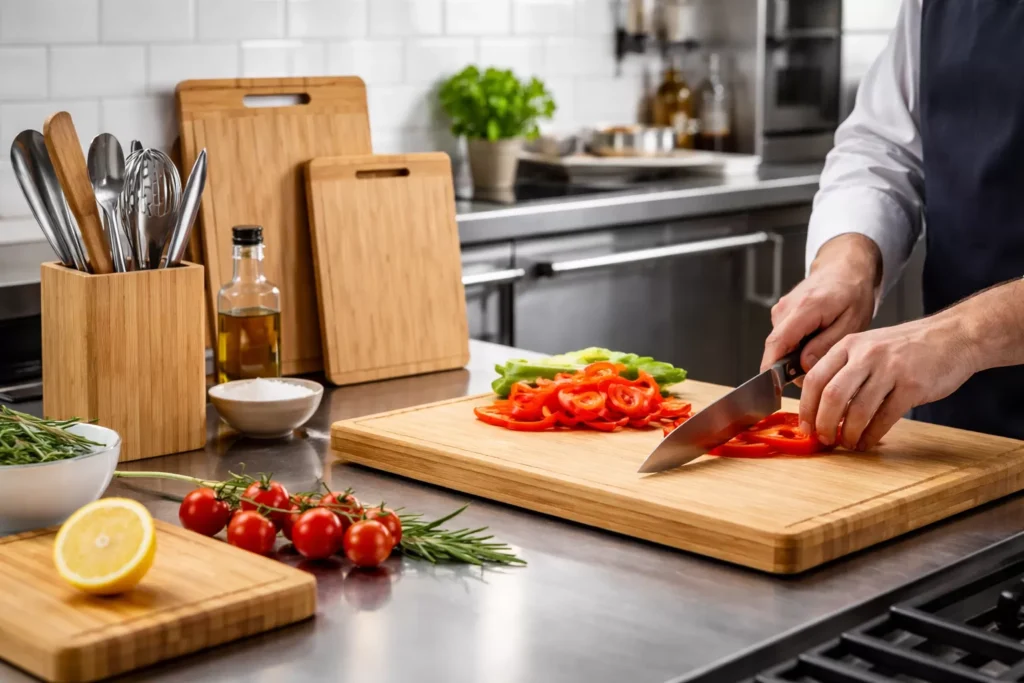
In a high-output culinary environment, a cutting board is a frontline tool, not a countertop accessory. The high-volume reality of a professional kitchen involves relentless impact from heavy knives, constant exposure to liquids, and rapid temperature fluctuations that would destroy standard retail equipment. For a chef, bamboo cutting board durability isn\’t about aesthetics—it is about operational safety and cost-efficiency.
Why Consumer-Grade Bamboo Fails
Retail-level bamboo boards are designed for occasional home use and light prep. In a professional setting, these \”consumer-grade\” boards typically fail due to:
- Structural Delamination: Standard adhesives break down under high-heat commercial sanitation cycles.
- Warping and Cupping: Poorly cured stalks and single-layer construction react aggressively to moisture, creating an unstable (and dangerous) cutting surface.
- Deep Scarring: Low-density fibers trap food particles, compromising food safety protocols.
Defining \”Chef-Grade\” Standards
As a dedicated bamboo products manufacturer, we engineer our boards to meet the rigorous demands of the global hospitality market. We define commercial-grade bamboo by three non-negotiable pillars:
| Metric | Professional Requirement |
|---|---|
| Mechanical Longevity | Must withstand heavy cleaver impact without longitudinal splitting. |
| Dimensional Stability | Remains perfectly flat despite constant \”wet-to-dry\” cycles. |
| Hygiene Integrity | High-density surface fibers that resist liquid absorption and bacterial nesting. |
In the professional world, a board must provide a reliable, knife-friendly surface that doesn\’t need replacing every three months. By focusing on high-density materials and advanced bonding techniques, Jibamboo products bridge the gap between sustainable sourcing and industrial-strength performance.
The Science of Strength: Cross-Laminated Construction
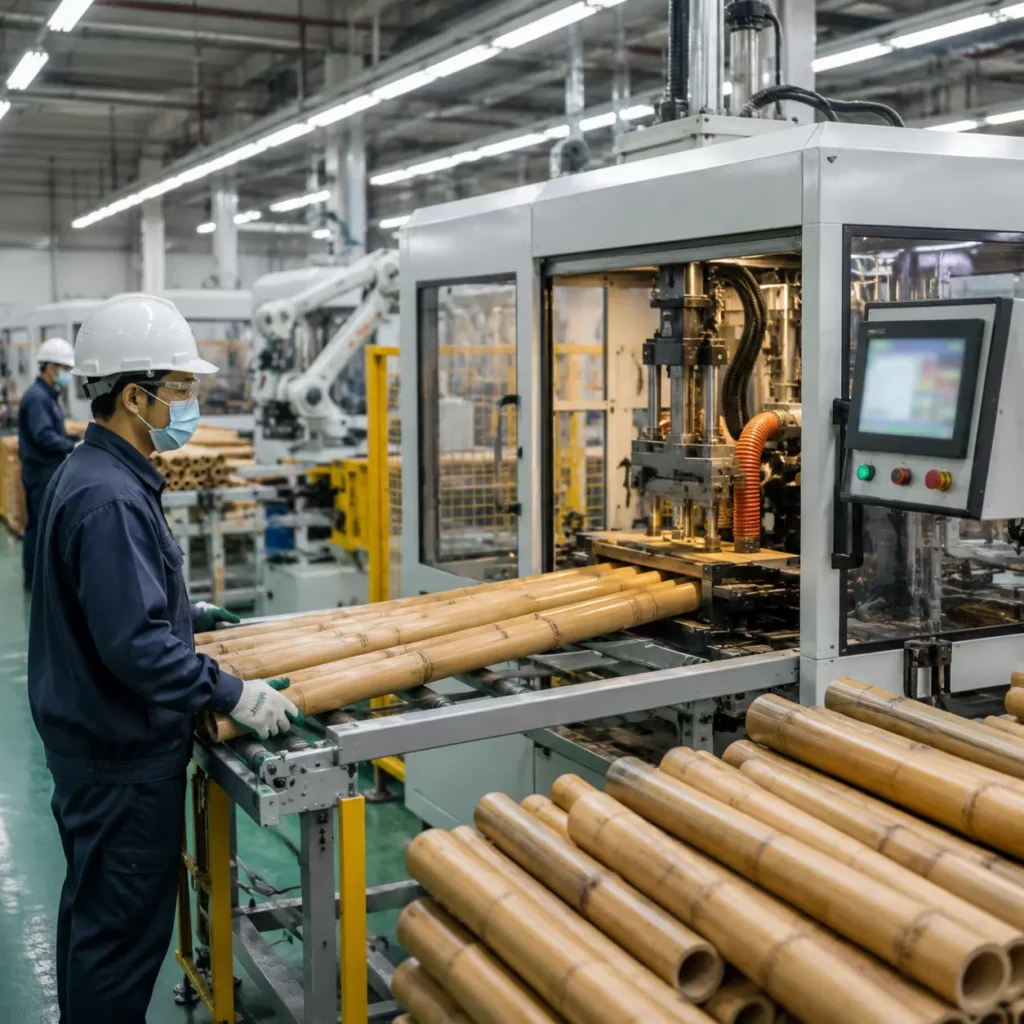
In a high-pressure commercial environment, a cutting board that warps is more than a nuisance—it’s a safety risk. We solve this through cross-laminated construction, a sophisticated 3-ply or multi-ply engineering process that ensures maximum warp-resistance.
Why Multi-Ply Engineering Matters
Standard bamboo boards often fail because they retain the \”memory\” of the natural stalk, causing them to bend when exposed to moisture. Our manufacturing process at Jibamboo layers the bamboo strips in alternating directions. This structural strategy:
- Neutralizes internal tension: Prevents the board from cupping or twisting under heavy use.
- Boosts tensile strength: Creates a dense, rigid surface that survives the high-volume impact of a professional kitchen.
- Increases longevity: Offers a significantly longer service life than single-ply consumer boards.
High-Heat Sanitation and Food-Safe Adhesives
Professional kitchens demand rigorous cleaning. We use specialized food-safe adhesives designed to maintain structural integrity during frequent sanitation. These bonds are tested to resist delamination even when exposed to the temperature shifts of a busy prep line. Much like the durability found in our bamboo bread bin with stainless steel handle, our cutting boards are built to remain stable and safe under constant daily pressure.
| Feature | Jibamboo Cross-Laminated | Standard Single-Ply |
|---|---|---|
| Warp Resistance | High (Multi-directional layers) | Low (Retains natural memory) |
| Structural Build | 3-Ply / Multi-Ply Engineering | Single Layer |
| Durability | Commercial Grade | Consumer Grade |
| Adhesive Quality | Heat-Resistant / Food-Safe | Standard Craft Glue |
By focusing on the science of the build, we provide a high-density prep board that stays flat, stays safe, and stays in your kitchen longer than traditional alternatives.
Debunking the Myth: Is Bamboo Too Hard for Professional Knives?
I often hear chefs worry that bamboo will ruin their expensive edges. This is a common misconception based on low-quality, \”consumer-grade\” boards. When we look at the Janka Hardness Scale, we see that high-quality bamboo sits in the \”sweet spot\” for kitchen use—harder than some softwoods but more resilient than many hardwoods.
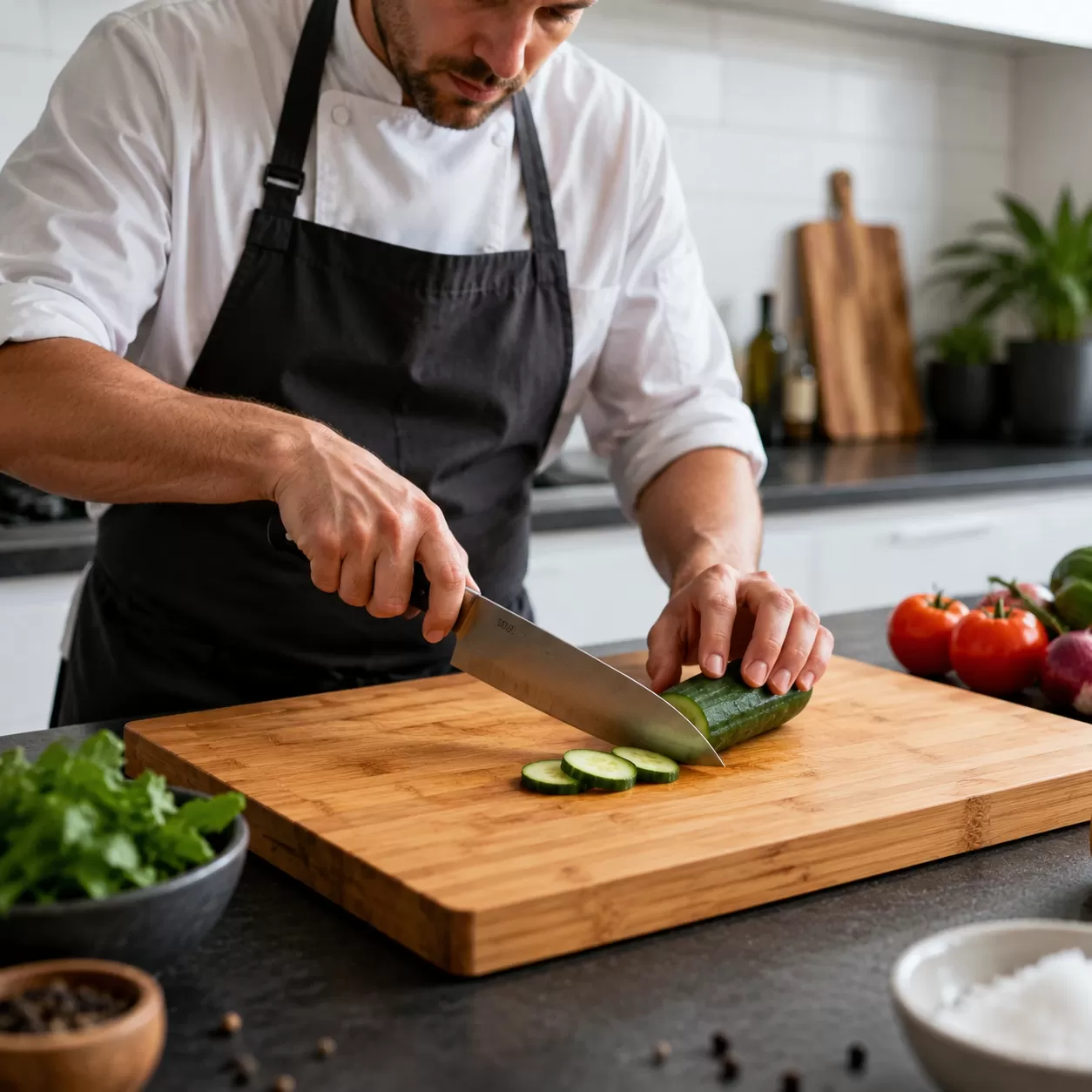
Our boards utilize premium Moso bamboo fiber, which offers a unique balance of strength and flexibility. Unlike plastic or glass, our knife-friendly surface is designed to have a \”self-healing\” quality. This means the fibers part slightly to accommodate the blade edge rather than resisting it with a hard, dulling surface.
Engineering a High-Density Prep Surface
We control the surface density during our manufacturing process to ensure the board provides enough \”give\” for high-speed prep work. By focusing on the cellular structure of the bamboo, we create high-density prep boards that protect your knife’s hone while maintaining the durability needed for a 12-hour shift.
| Feature | Moso Bamboo Performance | Impact on Your Knife |
|---|---|---|
| Fiber Density | High/Controlled | Prevents blade \”skating\” or \”bouncing\” |
| Resilience | Self-healing properties | Minimizes deep scoring and wood splinters |
| Surface Hardness | Optimized (approx. 1,380 Janka) | Comparable to Sugar Maple for edge retention |
Our commitment to quality means that whether you are using a standard chef knife or a custom bamboo paddle board, the material is processed to be gentle on your tools. We treat the surface to ensure it remains smooth and non-abrasive, avoiding the \”sandpaper effect\” found in poorly manufactured alternatives. For kitchens requiring versatile layouts, our extendable bamboo sink cutting board offers this same professional density in a space-saving design.

Bamboo Water Resistance and Microbial Safety
In a professional kitchen, moisture is the enemy of longevity. As a bamboo products manufacturer and supplier, I’ve seen how traditional hardwoods like Maple or Walnut eventually fail due to water saturation. Our commercial-grade bamboo is engineered to perform differently, focusing on two critical areas: natural hygiene and low absorption.
The Natural Defense of Bamboo Kun
Bamboo possesses a unique, natural bio-agent called \”Kun.\” This inherent antimicrobial property makes the surface naturally resistant to the growth of bacteria and fungi. Unlike plastic boards that develop deep grooves where microbes hide, our high-density bamboo provides a safer environment for food prep.
Testing Moisture Absorption Rates
We utilize a cross-laminated construction to lock out moisture. By layering the bamboo fibers, we eliminate the capillary action that causes standard wood to soak up liquids.
- Lower Porosity: High-density prep boards resist juice and blood penetration from raw proteins.
- Warp-Resistance: Minimal water intake means the board won\’t swell or crack during high-volume shifts.
- Faster Drying: A non-porous surface air-dries significantly faster than traditional timber, reducing the window for bacterial bloom.
Our commitment to high-performance kitchenware is evident in every piece we produce. This dedication to quality is why our sustainable hospitality supplies, including our 3-tier bamboo dessert stand with metal frame, are trusted by chefs who demand both aesthetics and rigorous food safety standards.
Preventing Cross-Contamination
The surface density of our boards ensures that food particles stay on the surface where they can be easily sanitized. By maintaining a low moisture absorption rate, we provide a kitchen tool that prevents cross-contamination and stays NSF-compliant under the most demanding commercial sanitation protocols.
Real-World Testing Metrics for Professional Kitchens
In a high-volume kitchen, \”good enough\” doesn\’t cut it. We put our commercial-grade bamboo through rigorous stress tests to ensure it survives the brutal pace of a professional line. Unlike standard boards, our cross-laminated construction provides the structural integrity needed to pass these three critical benchmarks:
The Impact Test: Cleaver Resilience
Cleaver work is the ultimate test of tensile strength. We test our boards against repeated heavy impacts. Because of our multi-ply engineering, the force is distributed across the fibers, preventing the board from splitting or cracking down the middle. This makes them significantly more durable than single-layer wood alternatives during heavy prep.
The Thermal Shock Test: Temperature Stability
Pro kitchens move fast. A board might go from a 4°C (40°F) walk-in refrigerator to a 38°C (100°F) prep station in minutes. Our boards are tested for warp-resistance under these specific conditions to ensure the surface stays flat, stable, and safe for high-speed knife work regardless of the ambient heat.
The Sanitation Test: Chemical and Moisture Resistance
We subject our surfaces to frequent washing cycles with harsh commercial detergents. The high-density bamboo fiber limits the moisture absorption rate, which prevents the material from \”fuzzing\” or degrading. This density is why a professional bamboo cutting board with drawers and graters remains a reliable choice for chefs who need organized prep tools that can withstand heavy-duty daily cleaning.
Durability Performance
| Test Category | Professional Requirement | Jibamboo Result |
|---|---|---|
| Impact Resistance | No splitting under heavy cleaver use | Pass (High Tensile Strength) |
| Thermal Stability | Zero warping during 30°C shifts | Pass (Cross-Laminated) |
| Chemical Resistance | High stability against surfactants | Pass (Non-porous surface) |
| Moisture Barrier | Low absorption to prevent bacteria | Pass (High-Density Fiber) |
Maintenance Protocols for Commercial-Grade Bamboo
To maximize results when testing bamboo cutting board durability for chefs, a consistent maintenance routine is essential. In a high-volume environment, the goal is to protect the structural integrity of the board while ensuring it remains a knife-friendly surface. My manufacturing process ensures these boards are tougher than standard wood, but they still require basic \”seasoning\” to repel moisture.
Essential Care Steps for High-Density Boards
- Seasoning Frequency: I recommend applying food-grade mineral oil at least once a week for boards in heavy rotation. This maintains the moisture barrier and prevents the bamboo fibers from becoming brittle.
- Identifying Wear: Regularly check for \”fuzzing\” (raised fibers) or delamination. While our cross-laminated engineering is designed to prevent splitting, detecting surface wear early allows for a quick light sanding to restore the finish.
- Sanitation: Use commercial-grade detergents but avoid soaking. High-density prep boards should be dried upright to allow even airflow to both sides.
Because Jibamboo products are built with a tighter grain structure, they require significantly less downtime for deep maintenance compared to maple or walnut. This efficiency is why many kitchens also integrate a bamboo pizza peel with cutter guide into their workflow; the material\’s natural resistance to warping makes it more reliable for fast-paced service than traditional softwoods.
Commercial-grade bamboo outperforms alternatives because it doesn\’t \”trap\” moisture as easily, meaning you spend less time resurfacing your equipment and more time on prep. By following these simple protocols, the ROI on your kitchen tools increases substantially.
Sustainability Meets Performance: The Manufacturer’s Edge
Investing in professional gear is about the long game. When testing bamboo cutting board durability for chefs, the Return on Investment (ROI) is significantly higher than traditional materials. We’ve engineered our boards to outperform common kitchen alternatives through superior density and structural design.
The High ROI of Commercial-Grade Bamboo
Standard plastic boards are cheap upfront but scar quickly, creating deep grooves that harbor bacteria and require frequent replacement. Softwoods like cedar or pine lack the tensile strength needed for high-volume chopping. Our commercial-grade bamboo offers a different trajectory:
- Longevity: Lasts 3-4x longer than plastic in high-impact environments.
- Hygiene: Naturally resistant to scarring, maintaining a smooth, easy-to-sanitize surface.
- Eco-Friendly: Sourced from rapidly renewable Moso bamboo, meeting the demand for sustainable hospitality supplies.
Sourcing and Scalability
As a dedicated bamboo products manufacturer and supplier, we understand that consistency is everything for bulk commercial orders. Our infrastructure is built to support large-scale hospitality needs while maintaining the same quality control standards we apply to our premium nesting bamboo octagon tray set for serving and other professional kitchenware.
| Material Type | Durability Level | Replacement Frequency | Environmental Impact |
|---|---|---|---|
| Jibamboo (Multi-ply) | Elite | Low | Excellent |
| Standard Plastic | Low | High | Poor |
| Softwood | Moderate | Moderate | Moderate |
By controlling the entire process from raw material to the final cross-laminated construction, we eliminate the variability often found in third-party sourcing. This ensures that every board delivered to a professional kitchen can withstand the grueling pace of a commercial line without warping or delamination.
FAQ: Testing Bamboo Cutting Board Durability for Chefs
As a dedicated bamboo products manufacturer and supplier, I hear the same concerns from executive chefs and kitchen managers regarding bamboo cutting board durability. Here are the direct answers to the most common questions we face in the professional culinary industry.
Is bamboo too hard for expensive chef knives?
This is a common myth. While bamboo ranks higher on the Janka Hardness Scale than some softwoods, our cross-laminated construction ensures the surface remains a knife-friendly surface. By utilizing specific Moso bamboo fibers, we create a board that is dense enough for longevity but resilient enough to prevent premature dulling of high-end steel.
Can bamboo boards go in a commercial dishwasher?
I strongly advise against it. Even with our industry-leading water resistance, the extreme heat and pressurized detergents in a commercial dishwasher can break down natural fibers and adhesives over time. To maintain the structural integrity of your commercial grade boards, a quick manual scrub and air-dry is the best practice.
How often should I oil a commercial-grade bamboo board?
In a high-volume kitchen, you should season your boards with food-grade mineral oil at least once a week. This prevents the bamboo from becoming brittle and maintains its \”self-healing\” properties. For specialized tools like a bamboo bread cutting board, regular oiling keeps the wood supple and prevents cracking during heavy service.
Is bamboo more sanitary than plastic for raw meat?
Yes. Studies consistently show that high-density bamboo possesses natural antimicrobial properties that plastic lacks. While plastic boards develop deep grooves that harbor bacteria, the dense surface of our bamboo resists deep scoring. For those looking to combine hygiene with branding, our custom engraved bamboo cutting boards provide a professional, non-porous prep area that meets rigorous safety standards.
Quick Comparison: Bamboo vs. Traditional Materials
| Feature | High-Density Bamboo | Plastic (HDPE) | Standard Maple |
|---|---|---|---|
| Durability | High (Cross-Laminated) | Medium | Medium |
| Knife Impact | Resilient | Deep Scarring | Moderate |
| Sanitation | Naturally Antimicrobial | High Risk (in grooves) | Neutral |
| Eco-Impact | Highly Sustainable | Petroleum-Based | Slow Regrowth |

Celia
Celia is a bamboo product manufacturing expert dedicated to green innovation and sustainable supply chain solutions. With over 10 years of industry experience, he helps global businesses build premium private-label eco products. Outside of work, he is an avid nature explorer.
Frequently Asked Questions

Get a Fast, Custom Bamboo Quote