How Fast Can Bamboo Grow for Business?
Most procurement managers assume bamboo takes decades to reach harvestable size. That mistake costs millions in delayed timelines and missed market cycles. Our Jibamboo engineering team has watched too many commercial projects stall because buyers trusted garden-blog anecdotes instead of field‑verified growth data.
We’ve seen the same pattern in construction, landscaping, and sustainable material sourcing: someone plugs “how fast will bamboo grow” into a search engine, gets a record‑breaking 91 cm/day factoid, and then plans a plantation around that number. The real world delivers something entirely different — and we’ve had to clean up the aftermath. This guide is what we wish every buyer understood before committing capital to a bamboo project.
How Fast Does Bamboo Actually Grow? (The Numbers That Matter)
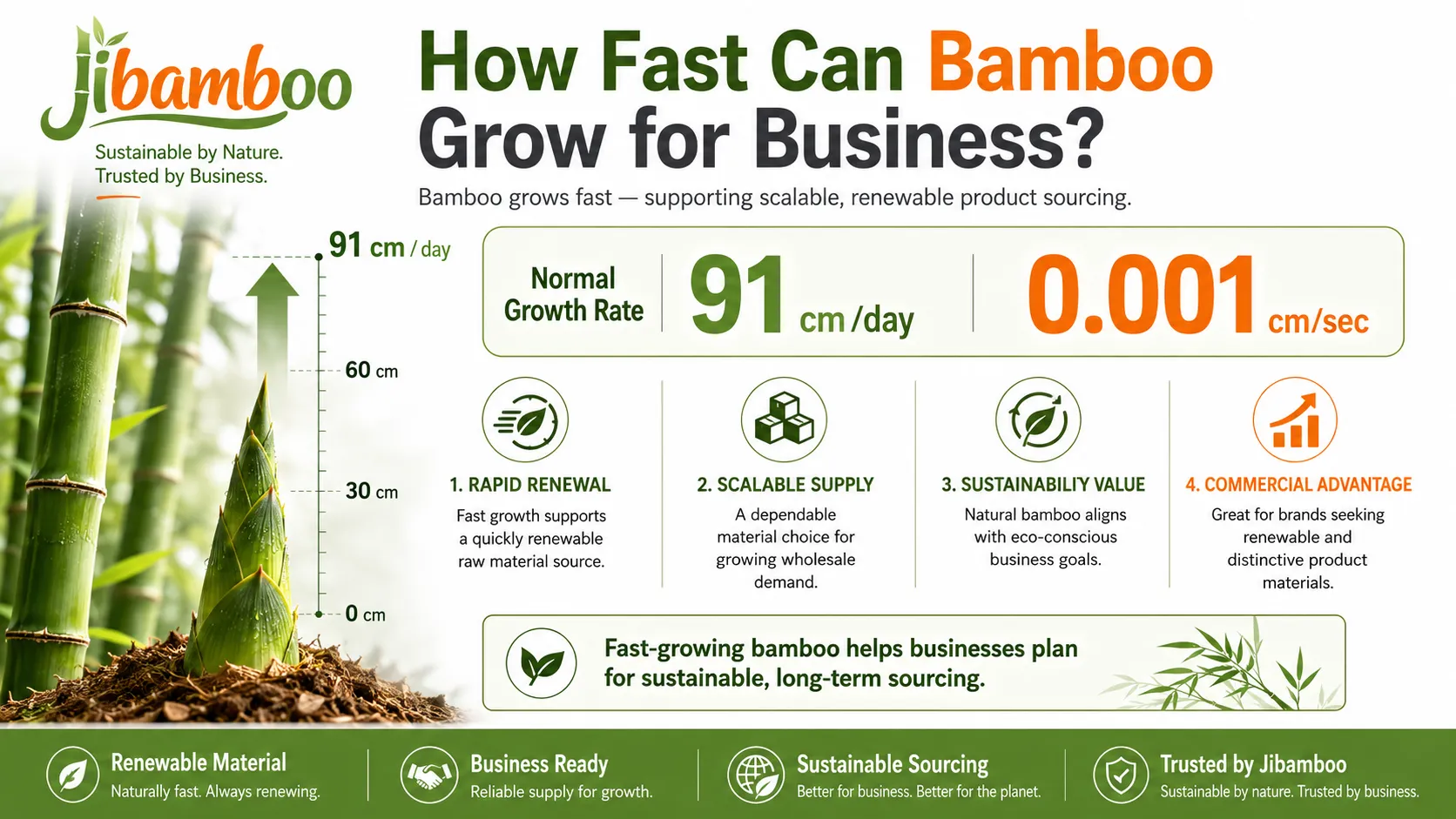
Record‑breaking daily and hourly growth rates (91 cm/day, 0.001 cm/sec) — what they really mean
Yes, certain species under laboratory‑perfect conditions can push a shoot 91 centimeters in 24 hours, equivalent to roughly 4 cm per second during peak elongation. That statistic gets repeated endlessly. In practice, those rates happen in a tightly controlled nursery with optimized soil, temperature, and hydration — not in a commercial plantation. The shoot is mostly water and pith at that stage; it has almost no structural value.
We treat these numbers as biological ceilings, not procurement targets. If you’re specifying bamboo for construction, landscaping, or timber, the rate that matters is the sustained daily gain across a shoot’s elongation window. In our supplier networks, a robust shoot might add 15–25 cm per day during the first month, then taper off. That’s practical, replicable growth — and it’s the difference between a profitable harvest cycle and a financial write‑off.
Realistic average growth for commercial species (3–5 ft/year for runners, 1–3 ft/year for clumpers)
When evaluating a species for a commercial site, forget the single‑day numbers. Instead, look at the annual culm production rate per rhizome system. Running bamboos — the Phyllostachys clan especially — typically add 3 to 5 feet of new culm height each year during establishment, with culm diameter increasing after year two. Clumpers like Bambusa or Dendrocalamus are slower to expand horizontally but can put up 1 to 3 feet of vertical gain annually while building a dense root mass.
These figures reflect what we’ve documented across working plantations in Southeast Asia and Central America. Jibamboo’s field‑tested averages account for real‑world variables: seasonal rainfall, competition from weeds, and early‑stage rhizome energy allocation. If a supplier claims twice that speed without showing you a three‑year growth log, ask for the nursery photos.
- Running bamboo (Phyllostachys edulis): 3–5 ft new culm height/year in zones 6–8
- Clumping bamboo (Bambusa oldhamii): 1–3 ft vertical gain/year until colony matures
- Giant tropical timber species (Dendrocalamus asper): 4–6 ft/year once rhizome mass exceeds 15 kg
We’ve published more detailed yield curves in our bamboo industry insights collection for anyone managing a multi‑year planting plan.
Bamboo Growth Timeline: From Shoot to Harvest‑Ready Culm
The 60‑day sprint: height and diameter development
A new culm emerges as a pointed shoot from the ground, covered in protective sheaths. Over the next 60 days, that shoot will achieve 90% of its final height and 80% of its final diameter. This is an intense period of cellular expansion driven entirely by water uptake and stored rhizome carbohydrates. No photosynthesis from the new culm occurs yet — the leaves unfold only after height elongation stops.
For a commercial grower, the 60‑day window dictates irrigation scheduling. Water stress during this sprint permanently reduces culm diameter and wall thickness, compromising structural grade. We recommend soil tension monitoring rather than timed irrigation, particularly for species like Guadua angustifolia that can photosynthesize through temporary sheath tissue and mask early drought stress.
The 6‑month mark: achieving structural strength
After the sprint, the culm enters a lignification and hardening phase. Over the next 4 to 6 months, lignin deposition increases, cellulose microfibrils cross‑link, and free water in the culm wall drops from over 100% moisture content to around 40%. How quickly do bamboo grow from a structural standpoint matters more than height: a culm that shot up 20 meters in 60 days still bends under its own weight until it hardens.
We’ve pulled immature culms from client sites that looked impressive but snapped under 50% of their expected load. These projects had advanced to framing before waiting for the full 6‑month hardening window. In our procurement conversations, we always push for on‑site culm‑stiffness testing after month 5 — a simple deflection jig and moisture probe can prevent costly failures. Our bamboo moisture sensitivity guide covers the post‑harvest testing protocol we use in our own processing facility.
Maturity for harvest: 3–5 years for construction‑grade bamboo
The “5‑year rule” is partly a myth, but it contains a kernel of truth. Individual culms can be harvested as early as year 3 if the plantation is well‑fed, but a whole clump reaches peak commercial yield between years 4 and 6. Culms harvested at year 3 show 15–20% lower modulus of elasticity compared to year‑5 culms from the same clump, according to our mechanical testing data.
We’ve distilled on‑site readiness into a simple checklist for project managers: culm color shift from green to mottled brown, sheaths detaching easily, and a “ring test” — a sharp tap produces a clear, high‑pitched tone. Request the full Bamboo Harvest Readiness Checklist from our support team before your first cut.
Species‑Specific Growth Rates (And Why It Matters for Your Project)
Running vs. clumping: growth speed, spread, and control
Running bamboos send out long, invasive rhizomes that can travel several feet underground in a single season. That aggressive spread means rapid area coverage — perfect for erosion control or quick biomass production — but a nightmare for a tight‑lot commercial farm without containment. Clumping bamboos expand outward from a central base just a few inches per year, so they take longer to fill a field but demand far less rhizome barrier infrastructure.
Procurement teams often ask us: “How fast can bamboo grow if we pick a runner but install a 30‑mil HDPE barrier?” The answer depends on soil type and slope. In sandy loam, a bamboo runner like Phyllostachys vivax can extend 6–7 feet laterally in one growing season; in heavy clay, it’s closer to 2–3 feet. We size barrier depth at 28 inches minimum for commercial runner plantations.
Top 5 commercial species: Moso, Guadua, Asper, Oldhamii, and Phyllostachys
The table below compares annual height gain, time to first commercial harvest, and primary use cases — data drawn from our supplier networks and published forestry reports. Use it as a selection starting point, not a final spec.
| Species | Type | Annual Culm Height Gain (ft) | Time to 1st Commercial Harvest (yrs) | Best For | Ideal Climate |
|---|---|---|---|---|---|
| Moso (Phyllostachys edulis) | Running | 3–5 | 5–6 | Flooring, structural poles | USDA 6–8, humid summers |
| Guadua (Guadua angustifolia) | Clumping | 4–6 | 4–5 | Scaffolding, beams | Tropical, 20–30°C year‑round |
| Asper (Dendrocalamus asper) | Clumping | 4–7 | 4–5 | Timber, shoots, biochar | Lowland tropical, high rainfall |
| Oldhamii (Bambusa oldhamii) | Clumping | 2–4 | 4–5 | Screens, light construction | Warm temperate to subtropical |
| Phyllostachys (P. vivax) | Running | 4–6 | 5–7 | Laminated boards, pulp | USDA 6–9, well‑drained soils |
Data source: Jibamboo plantation yield surveys 2019–2024; cross‑referenced with INBAR commercial growth reports. Actual results vary with soil, irrigation, and management intensity.
For a deeper dive into matching species to end uses, our bamboo applications overview maps over 30 product categories to specific cultivars. And when you’re ready to price out bulk rhizome divisions, refer to our bamboo sourcing guide for order minimums and lead times.
The 7 Factors That Accelerate (or Kill) Bamboo Growth
Climate and USDA zones
Bamboo’s growth engine runs on heat and humidity. Most commercial timber species perform best in USDA zones 8–10, where soil temperatures stay above 10°C for at least 8 months. In zone 6, you’ll need heavy mulch and wind protection to keep rhizomes alive, and new shoots may emerge 4 weeks later than in warmer microclimates. We’ve seen Florida plantations outpace zone‑7 sites by a factor of 1.8 in annual biomass accumulation — a difference that directly impacts ROI.
Read our field notes on how much sun bamboo needs to fine‑tune planting orientation on sloped parcels.

Soil preparation, irrigation, and fertilization
Bamboo demands well‑drained, slightly acidic soil (pH 5.5–6.5) with organic matter above 3%. Compacted clays will stunt rhizome penetration and cause “bottle‑brush” root deformities. On a recent installation in Georgia, we ripped the subsoil to 24 inches and incorporated 6 tons of compost per acre — the subsequent shoot emergence count jumped 40% over adjacent untreated rows.
Irrigation is non‑negotiable during the first two dry seasons. We design drip‑tape systems that deliver 1 inch of water per week, with tensiometers triggering cycles when soil tension exceeds 50 kPa. Fertilization follows a 3-1-2 NPK ratio at 200 kg/ha annually for mature timber stands, split into four applications timed with shoot emergence.
Age of rhizome system — why patience pays
Bamboo follows a “sleep‑creep‑leap” establishment pattern. Year 1: sparse shoots, most energy goes into rhizome exploration. Year 2: shoot count doubles or triples, but culms are smaller than mature potential. Year 3: the leap — the colony’s rhizome mass finally tips, and full‑size culms push up. Harvesting before year 3 robs the system of carbohydrate reserves and can set a plantation back by two seasons. We drill this into every client: the fastest path to commercial output is often the slowest start.
For a step‑by‑step guide on site preparation and early‑stage care, explore our bamboo growing tips library.
Bamboo Growth ROI: What Speed Means for Your Bottom Line
Growth rate isn’t a botanical curiosity — it’s the biggest lever on a bamboo operation’s payback period. A one‑year‑earlier harvest reduces carry costs by roughly 18% in our financial models, assuming a 7% discount rate. That’s why we obsess over the details that shave months off the cycle.
Planting a hectare of Guadua in Colombia typically costs $2,500–$3,500 for soil prep, rhizome stock, and first‑year irrigation. By year 5, that hectare yields 1,200–1,500 marketable culms, with a wholesale value of $8–$12 per 6‑meter pole depending on diameter. The math works: break‑even occurs between year 4 and year 5, after which annual net margins exceed 40%. Add carbon credit revenue — currently averaging $8–$15 per ton CO₂e for verified bamboo forestry projects — and the land becomes a dual‑income asset.
We’ve seen producers accelerate payback further by intercropping bamboo shoots for food markets during years 2–4. Dendrocalamus asper shoots fetch $3–$5 per kilogram in urban Asian markets, covering the entire establishment cost before the first timber harvest. This is the kind of layered ROI thinking that separates a commodity grower from a resilient business. Our about Jibamboo page details how we’ve supported plantation startups with planting stock and technical oversight.
Indoor Bamboo and Seed‑Grown Bamboo: Why They’re Wildly Different
How fast will bamboo grow indoors?
“Lucky bamboo” (Dracaena sanderiana) isn’t bamboo at all — it’s a tropical lily that grows a few inches per year in water. True indoor bamboos, like dwarf Buddha belly (Bambusa ventricosa ‘Kimmei’), can add 6–12 inches of new culm height annually under bright indirect light if root‑pruned regularly. But the growth rate is a fraction of outdoor performance. Photosynthetic photon flux density indoors rarely exceeds 50 µmol m⁻² s⁻¹, while outdoor full‑sun bamboos thrive at 1,500+ µmol m⁻² s⁻¹. That’s a 30‑fold light deficit.
We don’t recommend indoor bamboo for any project that requires structural material. If you need consistent culm dimensions for eco‑friendly bamboo products like kitchenware or storage, stick with field‑grown stock.
How fast does bamboo grow from seed — and why it’s rarely used commercially
Bamboo seed is small, short‑lived, and genetically unpredictable. Germination can take 3–8 weeks, and seedlings typically produce a single weak shoot the first year, reaching perhaps 12–18 inches. It then takes 3–5 more years for the plant to develop a rhizome system capable of producing market‑size culms. Worse, bamboo flowering is erratic — some species flower once every 60–120 years — so seed availability is unreliable.
For commercial production, we always specify rhizome divisions or tissue‑cultured plantlets. Those skip the juvenile phase and deliver genetically identical stock. A nursery‑raised Divisoria plant can produce its first harvestable culm in year 3, versus year 6+ from seed. If a supplier offers you “fast‑growing bamboo seeds,” ask for their three‑year plantation photo — you’ll usually get silence.
Debunking Bamboo Growth Myths That Delay Projects
“Does Bamboo Take 5 Years to Grow?” and Other Myths Costing You Time
The “5 years” myth originates from a misunderstanding of establishment. A newly planted bamboo colony does take about 5 years to reach full per‑acre production capacity, but individual culms emerge and reach full height each season within 2–3 months. The colony is active from year one — it’s just not at commercial scale yet. Calling it “dormant for 5 years” is inaccurate and leads project budgets to over‑allocate contingency funds or delay site work.
What actually happens: year 1, rhizomes explore soil; year 2, first small culms appear; year 3, culm size jumps; years 4–5, full‑sized harvests begin. You’re never “waiting for nothing.” We recommend phasing plantation leases to align with this ramp‑up — a strategy we’ve implemented with several landscape‑scale clients to avoid cash‑flow gaps.
Growth per week, month, and year — a visual guide
During peak shooting season, a healthy Guadua culm gains roughly 3 feet per week for 6–8 weeks. That translates to 12–15 feet per month, culminating in a 70–90 foot pole within a single growing season. After that season, the same culm will never grow taller — all future height comes from new shoots the following year. This seasonal punctuation shapes harvesting schedules: you’re cutting a “standing inventory” of mixed‑age culms, not a uniform crop.
We’ve prepared an infographic (contact our support team) showing a time‑lapse of a Guadua plantation over 12 months, with shoot height marked weekly. It’s the single most useful tool we’ve found for aligning construction‑project timelines with bamboo growth rhythms.
Frequently Asked Questions
How fast does bamboo grow in a day?
Under optimal conditions, some species can grow up to 91 cm (36 inches) in 24 hours, though commercial species typically achieve 10–20 cm per day during peak shooting season.
How quickly do bamboo plants reach their full height?
Most bamboo culms reach full height within 60–90 days, but they take several more months to harden and gain structural strength. Harvest‑ready quality usually comes after 3–5 years.
Does bamboo really spread and become invasive overnight?
Running bamboos can spread several feet per year if not contained, but proper barrier installation and species selection (clumping types) prevent this. Commercial growers manage spread for optimal yield.
How fast does bamboo grow in Florida?
Florida’s warm, humid climate accelerates growth. Many tropical clumpers like Bambusa vulgaris can reach 50 feet in 2–3 years, making it a prime region for bamboo farming.
What’s the fastest‑growing bamboo for commercial timber?
Dendrocalamus asper and Guadua angustifolia are top performers, with new shoots reaching over 25 meters in a single growing season and achieving structural maturity within 4–5 years.
Can bamboo growth be sped up for faster harvest cycles?
Yes — through optimal fertilization, irrigation, and selective thinning, growth rates can be improved by 20–30%, shortening the time to first commercial harvest by up to a year.

Celia
Celia is a bamboo product manufacturing expert dedicated to green innovation and sustainable supply chain solutions. With over 10 years of industry experience, he helps global businesses build premium private-label eco products. Outside of work, he is an avid nature explorer.
Frequently Asked Questions

Get a Fast, Custom Bamboo Quote